
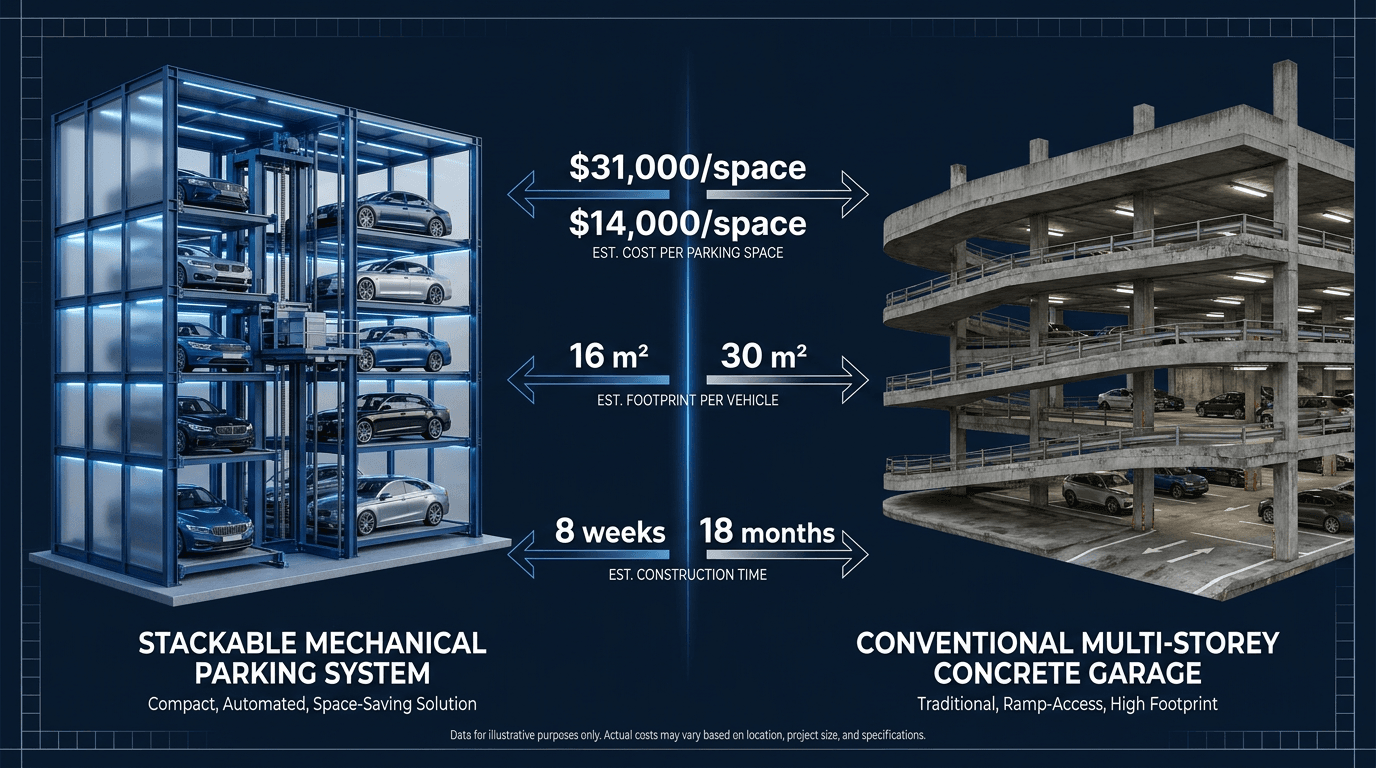

In prime urban land markets, a single square metre now costs more than $5,000 to acquire. A conventional ramp-access parking space consumes 30–35 m² once you account for drive aisles, structural columns, ramps, and ventilation shafts. A mechanical stacking system delivers the same parking capacity in 15–18 m². That difference—15 to 20 square metres per space—is not a technical footnote. At $5,000 per square metre, it is $75,000 to $100,000 of land value per parking space that you are either capturing or wasting.
This guide breaks down the true, full-cycle financial comparison between conventional multi-storey parking structures and mechanical stackable systems. We will model capital costs, hidden operational costs, opportunity costs, and payback periods across three real-world development scenarios. The goal is a decision-ready financial framework, not a sales pitch.
The Capital Cost Baseline: What You Are Actually Spending Per Space
Conventional Multi-Storey Parking Structures
According to the WGI 2025 Parking Structure Cost Outlook, the delivered cost of a conventional above-grade parking structure in major markets now ranges from $20,000 to $35,000 per space, with a median of approximately $31,000 across the United States. Underground structures—required in dense urban infill sites—push that figure to $30,000–$60,000 per space once you account for excavation, waterproofing, structural transfer slabs, and mechanical ventilation.
Those numbers include the full scope: structural concrete frame, MEP systems (mechanical, electrical, plumbing), fire suppression, signage, line marking, elevators, and project management. What they do not include is the opportunity cost of the land consumed, the financing carry during an 18–24 month construction period, or the 30-year operational cost the asset will accumulate.
A further structural problem is efficiency loss. In a typical ramp-access garage, 35–40% of the gross floor area is occupied by ramps, drive aisles, structural walls, and ventilation cores. A 500-space garage with a 3.0 m floor-to-floor height and 35% efficiency loss requires approximately 17,500 m² of gross floor area to deliver 500 net parking spaces. Every one of those square metres was either purchased at land value or built at construction cost—but only 65% of them are generating the parking revenue the structure was built to provide.
Mechanical Stackable Car Parking
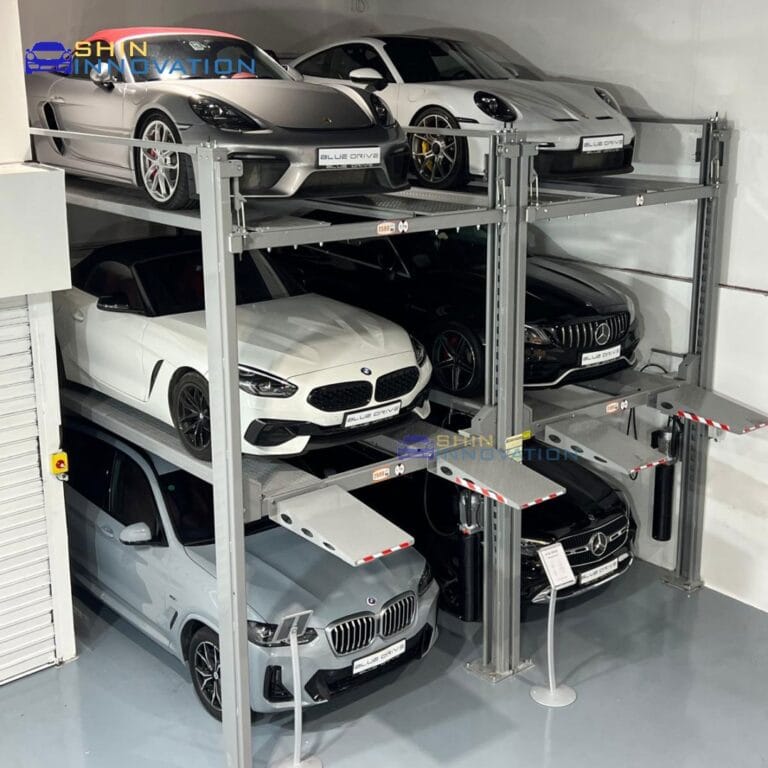
A mechanical stackable system delivers parking capacity through vertical multiplication rather than horizontal expansion. Equipment costs for two-post and four-post hydraulic stacker systems range from $9,000 to $25,000 per space depending on capacity (typically 2,000–3,500 kg), lift height, and automation level. Civil foundations—anchor bolt embedment for surface-mounted systems, or a shallow pit for flush-entry designs—add $2,000–$5,000 per space. Installation and commissioning typically represents 15–25% of equipment cost.
The critical difference is deployment speed. From equipment delivery to operational handover, a 50-space stacker installation takes 6–10 weeks. A 200-space project takes 12–16 weeks. A conventional concrete structure of equivalent capacity takes 12–24 months. That 12–18 month difference in construction timeline directly affects financing carry costs, revenue commencement dates, and project risk exposure.

Side-by-Side Capital Comparison
| Metric | Conventional Multi-Storey | Mechanical Stacker | Difference |
|---|---|---|---|
| Capital cost per space | $31,000–$50,000 | $12,000–$30,000 | 40–60% lower |
| Land footprint per space | 30–35 m² | 15–18 m² | 45–50% lower |
| Construction timeline | 12–24 months | 6–16 weeks | 10–15× faster |
| Structural flexibility | Permanent, irreversible | Modular, expandable | — |
| Planning risk | Full planning application required | Often permitted development | Significantly lower |
The Hidden Costs Developers Consistently Underestimate
The Opportunity Cost of Built Floor Area
The most significant financial variable in any parking decision is rarely included in the initial cost comparison: the revenue value of the floor area that parking infrastructure consumes. A parking space generates parking revenue. The same floor area, if converted to retail, office, or residential use, generates a fundamentally different income profile.
Consider a 500-space urban mixed-use development. The conventional approach—a five-storey above-grade parking structure—requires approximately 17,500 m² of gross floor area. A mechanical stacker system delivering the same capacity occupies approximately 10,500 m² (at 21 m² per space including operational clearances). The difference is 7,000 m² of floor area that the stacker solution makes available for revenue-generating use.
At a conservative retail or office rental rate of $30/m²/month, those 7,000 m² generate $2,520,000 in additional annual revenue. Over a 30-year asset life, that is $75,600,000 in foregone income—a number that makes the capital cost difference between the two parking systems look trivial by comparison.
30-Year Operational Cost Comparison
Operational costs are frequently omitted from parking feasibility studies because they fall outside the capital budget. Over a 30-year period, they represent a substantial hidden liability for conventional structures. Based on data from the Automated Parking Company’s 30-Year TCO Study, the operational cost gap between conventional and mechanical systems is significant:
| Cost Category | Conventional Structure (per space/year) | Mechanical Stacker (per space/year) |
|---|---|---|
| Annual maintenance | $500–$1,500 | $200–$600 |
| Energy (lighting, ventilation) | $800–$1,200 | $150–$400 |
| Staffing (attendants, security) | 2–4 FTE for 200-space facility | 0–1 monitoring operator |
| Structural repairs (decade 2–3) | $3,000–$8,000 per space | Hydraulic/mechanical overhaul: $1,000–$2,500 |
| 30-year total opex per space | $45,000–$80,000 | $12,000–$30,000 |
The energy cost difference alone reflects the fundamental design difference: conventional structures require continuous lighting across all levels and mechanical ventilation that must meet code minimum air change rates regardless of occupancy. A mechanical stacker system lights only the active loading bay during a retrieval cycle; the stored vehicles occupy unlit vertical stacks.
Financing and Depreciation Advantages
Mechanical parking equipment is classified as personal property or equipment under most accounting frameworks, qualifying for accelerated depreciation over 7–10 years. A conventional concrete parking structure depreciates over 39 years under US IRS rules (and similarly long periods under IFRS and most European accounting standards). The tax shield value of accelerated depreciation on a $2,000,000 equipment installation is material in a project’s early-year cash flow, particularly during the lease-up phase when the development is still reaching stabilised occupancy.
A further financing consideration is modularity: a stacker system can be procured and financed in phases aligned with actual demand growth. A concrete structure must be built to its maximum planned capacity from day one, regardless of how quickly occupancy reaches that level.
Payback Period Modelling: Three Real-World Scenarios
ROI calculation for a parking decision reduces to two variables: the capital cost saving from choosing a stacker over concrete, and the value of the additional revenue-generating floor area that the stacker solution makes available. The following three scenarios model this across different development typologies.
Scenario A: Residential Development with 50-Space Parking Requirement
Context: A 120-unit residential building in a European or Asian city-fringe location. Planning requires 50 car parking spaces. Land cost: $3,000/m².
| Conventional Ground-Level Structure | Double-Deck Stacker System | |
|---|---|---|
| Equipment / construction cost | $1,750,000 | $650,000 |
| Land footprint occupied | 1,750 m² | 925 m² |
| Land footprint released | — | 825 m² (repurposed as landscaping or additional units) |
| Construction timeline | 14 months | 8 weeks |
| Capital cost saving | — | $1,100,000 |
| Payback period (via parking revenue) | — | 4–6 years |
In this scenario, the stacker system pays back its capital cost premium through parking revenue alone within four to six years—before any value is attributed to the released land area. If the developer converts the 825 m² saving into additional residential units or communal amenity space, the financial benefit is front-loaded at practical completion rather than recovered over time.
Scenario B: Urban Mixed-Use Development with 200-Space Underground Requirement
Context: A high-density mixed-use scheme in a prime urban location. Planning requires 200 parking spaces. The site cannot accommodate an above-grade structure. Two options are evaluated: a two-level underground concrete structure, or a below-grade mechanical stacking system.
| Underground Concrete (2 levels) | Below-Grade Mechanical Stacker | |
|---|---|---|
| Total capital cost | $9,000,000 | $5,200,000 |
| Capital cost saving | — | $3,800,000 |
| Floor area released (B1 level) | — | ~2,800 m² |
| Revenue from released B1 floor area | — | $1,000,000+/year (retail) |
| Construction timeline | 20 months | 16 weeks |
| Combined payback period | — | 3–4 years |
This scenario illustrates the compounding effect when capital cost savings are combined with rental income from recaptured floor area. The $3,800,000 capital saving and $1,000,000 annual rental uplift together produce a payback period of under four years on the total investment differential—a return profile that comfortably exceeds most commercial real estate hurdle rates.
Scenario C: Luxury Residential or Boutique Hotel — Brand Value Premium
Context: An 80-space parking requirement for a 100-unit luxury residential development or boutique hotel. The target buyer or guest demographic places a premium on security, convenience, and design quality.
In this typology, the mechanical parking system is not simply a cost-reduction tool—it becomes a marketable amenity. Automated or semi-automated parking eliminates the risk of vehicle damage from tight ramp manoeuvring, removes the ambient noise and fume exposure of a conventional garage, and provides a demonstrably superior user experience. Luxury residential buyers in markets including Singapore, Hong Kong, Dubai, and major European capitals respond measurably to this differentiation.
Conservative market data suggests that the inclusion of a premium mechanical parking system contributes a 5–8% uplift to residential unit pricing in the luxury segment. For a 100-unit scheme with an average sale price of $8,000/m² and an average unit size of 80 m²:
- Total gross development value: $64,000,000
- 5% pricing premium attributable to parking amenity: $3,200,000
- 8% premium: $5,120,000
- Premium parking system cost vs conventional: approximately $800,000
- Net value contribution: $2,400,000–$4,320,000 above system cost
In this scenario, the mechanical parking system is not a cost to be minimised—it is a value-creation tool that returns multiples of its installation cost through product positioning and sales price.
Matching the System to Your Project: A Decision Framework
Not all mechanical parking systems are equivalent, and the financial case for each depends on accurate system selection. The following matrix maps project characteristics to the appropriate stacker typology.
| Project Characteristics | Recommended System | Primary Rationale |
|---|---|---|
| Under 100 spaces, clear height ≥ 5.8 m | Two-post or four-post hydraulic stacker | Lowest capital cost, fastest deployment |
| 100–300 spaces, constrained footprint | Multi-level stacker or vertical circulation | Highest space efficiency per m² |
| Over 300 spaces, fully automated requirement | Automated Parking System (APS) | Lowest long-term staffing cost, zero vehicle damage risk |
| Below-grade retrofit, clear height < 3.0 m | Custom low-headroom stacker | Specialist engineering required; only viable mechanical option |
| Temporary or relocatable requirement | Demountable stacker system | No permanent asset, full mobility |
Before engaging with any system supplier or preparing a financial model, three questions must be answered with precision:
- What is the minimum clear height available at each proposed installation position? This is the binding constraint that determines which systems are technically feasible. A 10 mm error here invalidates the entire financial model.
- Is the parking demand continuous or peak-driven? A residential development has a continuous high-utilisation demand profile. A retail centre has pronounced peak demand with long idle periods. The appropriate system type and sizing differs significantly between the two.
- What is the intended asset life of the project? A 10-year development play has a fundamentally different depreciation and payback logic than a 30-year hold. Accelerated depreciation of mechanical equipment is most valuable in the first 10 years; beyond that, the comparison shifts toward replacement cycle planning.
Case Study: 120-Space Mixed-Use Development in Bangkok, Thailand
In 2024, a Bangkok-based developer was planning a mixed-use commercial project requiring 120 parking spaces. The initial design called for a four-storey conventional ramp-access parking structure integrated into the building podium.
The Original Plan
- Solution: Conventional four-level reinforced concrete parking structure
- Total budget: $3,600,000
- Construction timeline: 18 months
- Usable floor area occupied: approximately 4,200 m²
- Revenue-generating floor area displaced: approximately 1,200 m² of potential ground-floor retail
The Revised Approach
Following a value-engineering review, the team evaluated a ShinInnovation multi-level hydraulic stacker system. The site’s clear height of 6.2 m permitted a double-deck configuration, and the load-bearing capacity of the existing slab was sufficient to avoid a pit foundation.
- Solution: ShinInnovation 60-unit double-deck stacker system (120 spaces total)
- Total cost including civil works and installation: $2,100,000
- Deployment timeline from equipment delivery: 14 weeks
- Ground-floor area released: 1,200 m² (converted to retail units)
Financial Outcome
| Metric | Result |
|---|---|
| Capital cost saving vs original plan | $1,500,000 |
| Construction time saving | 14 months |
| Retail floor area released | 1,200 m² |
| Annual rental income from released retail space | ~$720,000/year |
| Combined payback period on investment differential | 2.1 years |
The 14-month reduction in construction programme also meant the retail podium opened 14 months earlier than originally planned, accelerating the revenue commencement date across the entire project—a benefit not captured in the headline payback figure above.
Questions Developers Ask Before Committing
The following questions represent the most consistent points of uncertainty we encounter during developer feasibility discussions. They are addressed here in the order they typically arise.
Will a mechanical parking system affect project financing?
Generally, no—and often the reverse. Lenders assess parking provision as part of project viability underwriting, and a fully operational mechanical system with an established supplier warranty is treated equivalently to a conventional structure for lending purposes. The capital cost saving may actually improve loan-to-cost ratios and debt service coverage metrics, improving the financing terms available to the project. Equipment-specific financing (asset-backed lending or leasing) is also available and can further reduce the up-front equity requirement.
What happens if the system fails? What is the redundancy plan?
ShinInnovation systems are designed with dual hydraulic circuits and independent motor drives per lift unit. In the event of a primary drive failure, the secondary circuit maintains platform position and enables a controlled lowering sequence to retrieve the stored vehicle. All systems include a manual override mechanism operable by a trained technician in the event of total power failure. Our standard service agreement includes a 4-hour response time for urban locations. Critically, a failure in one lift unit does not affect adjacent units—the system degrades gracefully rather than failing completely.
How is vehicle damage liability handled?
Vehicle damage liability follows the same framework as a conventional valet or attended parking operation: the parking operator holds the liability during the period of custody. ShinInnovation provides comprehensive technical documentation—including load capacity certifications, safety sensor specifications, and CE conformity declarations under EN 14010:2003+A1:2009—which are typically required by insurers when underwriting a mechanical parking installation. The safety sensor suite (infrared obstruction detection, platform position confirmation, weight overload prevention) significantly reduces the frequency of damage events compared to conventional open-access parking.
Will planning authorities and building control approve a mechanical system?
In most jurisdictions, yes—provided the system carries appropriate certification. All ShinInnovation products are CE-marked and tested to EN 14010 requirements, with third-party TÜV inspection certification available on request. In the European Union, CE marking under the Machinery Directive 2006/42/EC is the standard basis for building control acceptance. We provide full documentation packages—including structural calculations, electrical schematics, maintenance manuals, and conformity declarations—formatted for inclusion in planning submissions and building regulation applications.
Can individual parking spaces be sold as separate title units?
This depends entirely on the jurisdiction’s strata title or unit title legislation, not on the parking technology. In most markets where individual parking space titles are legally permissible (Singapore, Hong Kong, the UK, Australia, and many European jurisdictions), a mechanical parking space can be registered as a separate title unit in exactly the same way as a conventional space. The title is assigned to the stacker position number, with the physical equipment managed as a common property asset under the owners corporation or management company. We recommend legal advice specific to the project jurisdiction at the feasibility stage.
Request a Custom ROI Model for Your Project
The scenarios above are illustrative frameworks. The financial case for your specific project depends on your site’s actual parameters: available clear height, parking space requirement, land cost per square metre, intended use for released floor area, and project hold period.
Our engineering team prepares bespoke financial models for qualifying development projects at no cost. The model covers capital cost comparison, 30-year operational cost projection, opportunity cost analysis for released floor area, payback period under multiple revenue assumptions, and system selection recommendation with technical rationale.
To receive your model within five working days, send us the following information via our Engineering Support portal or the contact form below:
- Number of parking spaces required
- Available clear height at the proposed installation area
- Site location and approximate land cost per m²
- Intended use for any floor area that would be released by a stacker solution
- Project type (residential, commercial, hospitality) and anticipated hold period
Response within 5 working days. No obligation. All project data treated in strict confidence.
Related reading: Engineering Support Hub · Custom Car Parking Systems: Engineering Guide for Architects · Car Parking Lift Solutions · Stacker Parking System: Complete Overview
Found this engineering guide helpful?
Share it with your professional network on LinkedIn to help others optimize their parking projects.
Share on LinkedIn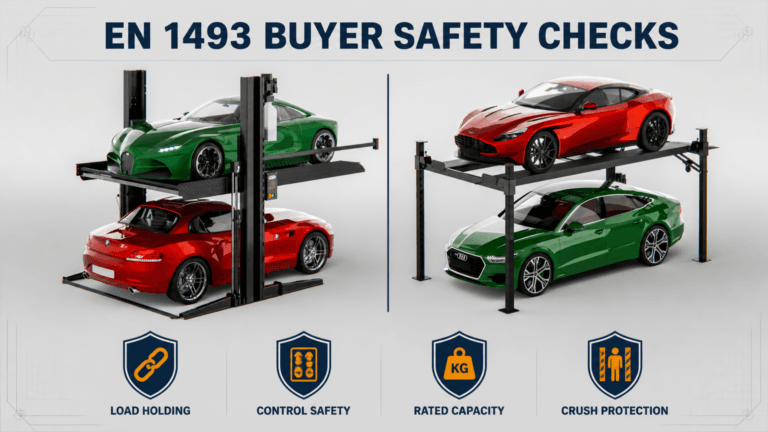


[…] ROI Analysis: Stackable Car Parking vs. Multi-Storey ConstructionMay 18, 2026 […]
[…] ROI Analysis: Stackable Parking vs Multi-Storey Construction […]