
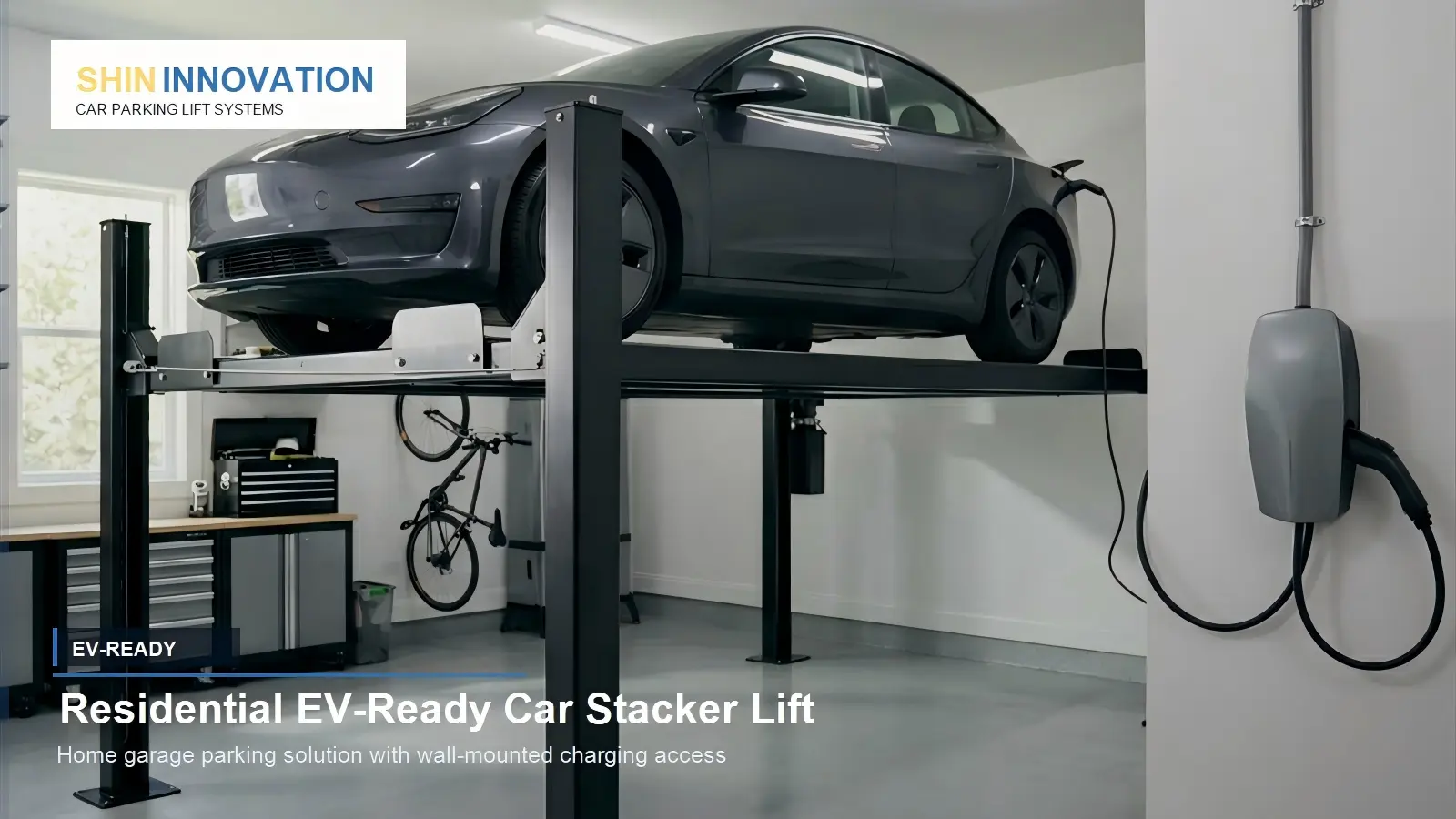

Electric vehicles are no longer a niche. In 2026, governments worldwide are rewriting building codes to mandate EV charging in every new residential parking space. For homeowners and builders considering a car stacker lift, this raises a critical question: Is your parking lift ready for the EV era?
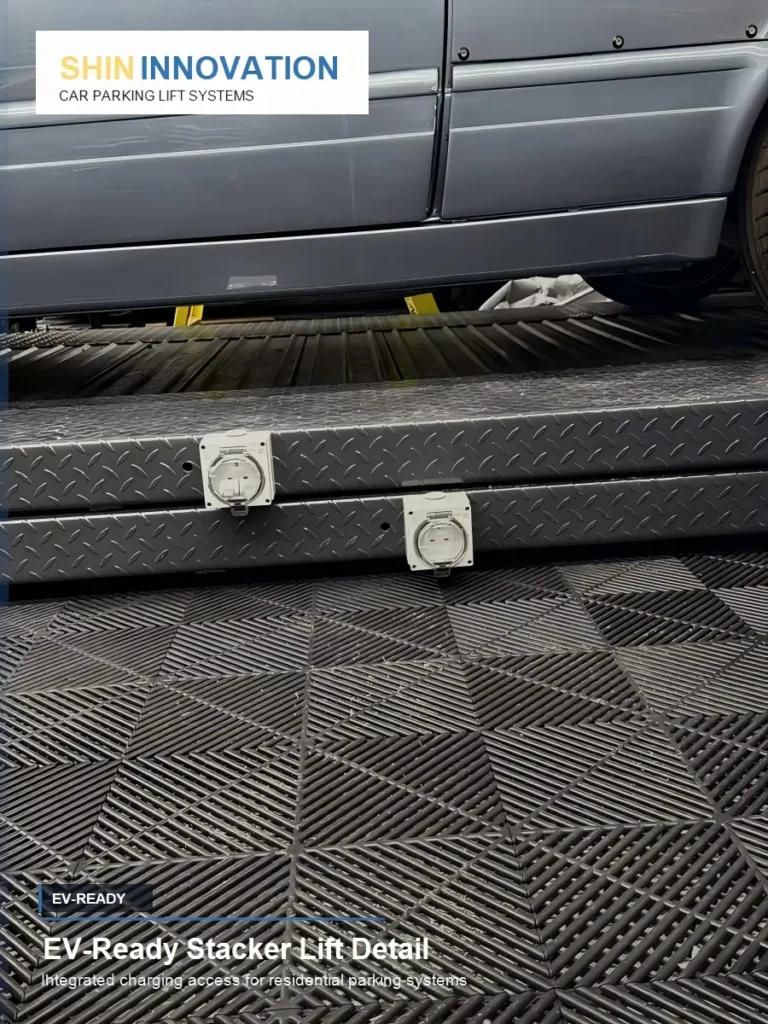
The 2026 Regulatory Shift: Why EV-Ready Parking Is Now Mandatory
Two major regulatory frameworks took effect in 2026 that directly impact residential parking equipment selection:
California CALGreen 2025 (Effective January 1, 2026)
- Single-family homes: Each dwelling unit requires at least one EV-Capable parking space with dedicated circuit and conduit.
- Multifamily dwellings: One EV-Ready (Level 2 outlet or charger) space per dwelling unit. Plus 25% of unassigned/common parking spaces must have operational EV chargers.
- Hotels/Motels: 40% EV-Ready and 25% EV Chargers on total parking spaces.
- These requirements apply to all new construction and major renovations submitted after January 1, 2026.
Source: California Green Building Standards Code 2025
EU Energy Performance of Buildings Directive (EPBD IV)
- New residential buildings with more than 3 parking spaces must install at least one charge point and pre-cable every single parking space.
- Non-residential buildings with more than 5 parking spaces: minimum 1 charge point per 5 spaces, plus pre-cabling for at least 50% of spaces.
- Major renovations of existing buildings with more than 10 parking spaces: pre-cabling required for every parking space.
- Member states had until May 2025 to transpose EPBD IV into national law; enforcement begins throughout 2026.
Source: European Commission – EPBD
For exporters targeting both North American and European markets, these parallel regulations mean one thing: any car stacker lift sold in 2026 and beyond must accommodate EV charging infrastructure.
Why EV Weight Matters for Car Stacker Lifts
Electric vehicles are 20-30% heavier than their petrol equivalents due to battery pack weight:
| Vehicle Type | Petrol Weight | EV Weight | Difference |
|---|---|---|---|
| Compact Hatchback | 1,200-1,400 kg | 1,500-1,800 kg | +20-25% |
| Family Sedan | 1,500-1,700 kg | 1,800-2,200 kg | +15-20% |
| Large SUV | 2,000-2,300 kg | 2,700-3,000+ kg | +30-40% |
| Pickup Truck | 1,950-2,300 kg | 2,700-4,100 kg | +40-75% |
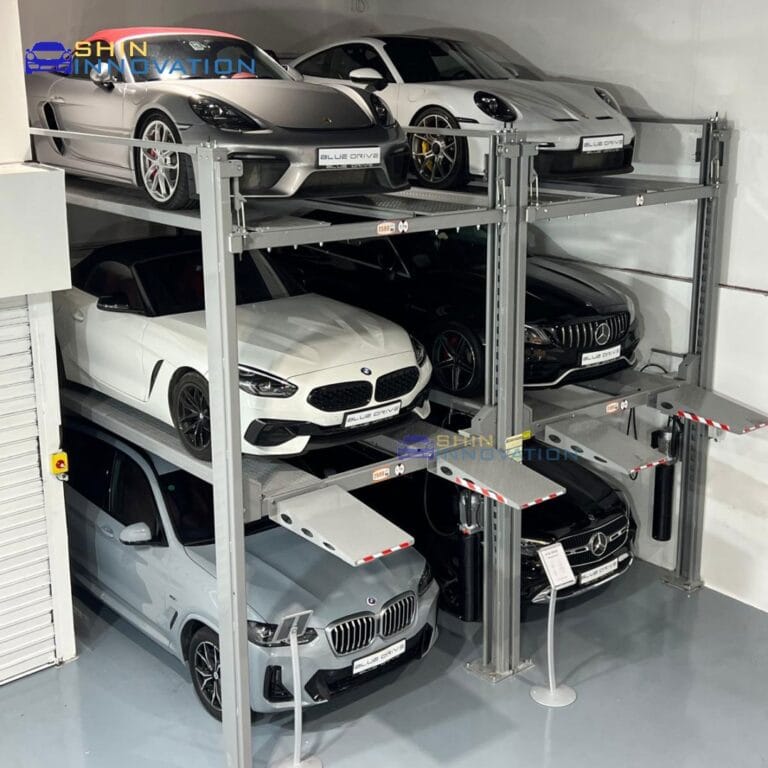
The GMC Hummer EV SUV exceeds 4,080 kg (9,000 lbs). A standard home garage car stacker rated for 2,500 kg per platform is already undersized for the next generation of family EVs.
5 Key Features That Make a Car Stacker Lift EV-Ready
1. Higher Weight Capacity (3,000+ kg per Platform)
Traditional residential stackers are often rated for 2,000-2,500 kg. An EV-ready stacker should support at least 3,000 kg (6,600 lbs) per platform to accommodate large EV SUVs and future models with bigger batteries.
2. Integrated Cable Management and Charging Conduits
The platform design should include built-in cable routing channels and mounting points for Level 2 charging stations. This eliminates the need for aftermarket modifications and ensures compliance with NEC Article 625 for EV charging equipment installation.
3. Extra Platform Clearance for Charging Ports
EV charging ports are often located on the front fender, rear quarter panel, or grille area — positions that may be obstructed in tight stacker configurations. An additional 20-30 cm of side clearance should be considered in platform design.
4. Fire-Rated and Ventilated Design
Lithium-ion battery fires present unique challenges in enclosed parking environments. EV-ready stackers should be constructed with fire-rated steel and incorporate ventilation channels to dissipate heat in the unlikely event of thermal runaway. Reference: NFPA 88A (Standard for Parking Structures).
5. Smart Load Management Compatibility
When multiple EVs charge simultaneously in a residential garage, total electrical load can exceed the home panel capacity. EV-ready stackers should integrate with smart load management systems that dynamically balance power between EV chargers and household appliances.
V2G (Vehicle-to-Grid): The Next Frontier
Vehicle-to-Grid technology allows EVs to discharge power back to the grid or home during peak demand. The global V2G market is projected to grow at 25%+ CAGR through 2030. For car stacker manufacturers, this means designing platforms that accommodate:
- Bi-directional charging hardware mounting
- Communication wiring between vehicle, charger, and building energy management systems
- Thermal management for sustained charging/discharging cycles
What This Means for Your Home Garage Project
| Scenario | Recommendation |
|---|---|
| You own a compact EV (Nissan Leaf, Tesla Model 3) | 2,700 kg platform minimum; ensure cable routing for Level 2 charger |
| You own an EV SUV (Tesla Model Y, IONIQ 5) | 3,000 kg platform minimum; verify side clearance for charging port access |
| You own an EV pickup (F-150 Lightning, Silverado EV) | 3,500+ kg platform; consult manufacturer for heavy-duty stacker options |
| You are a builder/developer | Specify EV-ready stackers in all new construction to meet CALGreen/EPBD compliance |
| You export to EU/California markets | All stacker models must be pre-configured for EV charging integration |
Conclusion
The intersection of EV adoption and parking infrastructure regulation is creating a new product category: the EV-ready car stacker lift. At ShinInnovation, our engineering team designs parking lift systems with forward-compatible weight ratings, integrated charging conduits, and fire-safe construction to meet 2026 regulatory requirements across North America and Europe.
Whether you are a homeowner planning a garage upgrade or a developer specifying parking equipment for a multi-unit project, choosing an EV-ready stacker today avoids costly retrofits tomorrow.
Wichtige EU-Regelungen fur Deutschland (Zusammenfassung auf Deutsch)
Ab 2026 gilt in Deutschland eine erweiterte Ladeinfrastrukturpflicht fur alle neuen Wohn- und Nichtwohngebaude. Grundlage ist die europaische Gebauderichtlinie EPBD IV in Verbindung mit dem Gebaude-Elektromobilitatsinfrastruktur-Gesetz (GEIG). Bauherren, Architekten und Planer mussen bei der Auswahl eines Auto-Parkliftsystems folgende Anforderungen berucksichtigen:
- Neubau Wohngebaude ab 6 Stellplatzen: Verpflichtende Vorverkabelung fur jeden Stellplatz (Leerrohre und dimensionierte Zuleitung).
- Neubau Nichtwohngebaude ab 6 Stellplatzen: Mindestens ein Ladepunkt plus Vorverkabelung fur ein Drittel der Stellplatze.
- Sanierung von Gebauden mit mehr als 10 Stellplatzen: Nachrustung der Vorverkabelung fur alle Stellplatze erforderlich.
- EV-Ready Parklifts: Wahlen Sie Systeme mit einer Traglast von mindestens 3.000 kg pro Palette (Berucksichtigung der 20-30% hoheren Fahrzeuggewichte durch Batteriemasse) und vorbereiteten Kabelfuhrungen fur Wallboxen bis 22 kW.
- Brandschutz: Beachten Sie die aktuellen Empfehlungen der Bundesanstalt fur Materialforschung (BAM) zur Lithium-Ionen-Batterie-Sicherheit in geschlossenen Parkgaragen. Lueftungs- und Sprinkleranforderungen konnen sich lokal unterscheiden.
Fur eine detaillierte deutschsprachige technische Beratung oder ein CE-zertifiziertes Angebot fur Ihr Projekt kontaktieren Sie unser Engineering-Team unter shincarlift.com/contact oder per E-Mail. Alle ShinInnovation Parklifte werden mit deutschsprachigen Installations- und Wartungsunterlagen geliefert.
Belangrijkste EU-Regelgeving voor Nederland (Samenvatting in het Nederlands)
De Nederlandse Bouwbesluit 2012 (nu Besluit bouwwerken leefomgeving, Bbl) verplicht sinds 2020 laadinfrastructuur bij nieuwbouw, aangescherpt door de EU EPBD IV richtlijn per 2026. Voor projectontwikkelaars, architecten en woningcorporaties zijn de volgende punten cruciaal bij de keuze van een autoparkeersysteem:
- Nieuwbouw woongebouwen met meer dan 3 parkeerplaatsen: Verplicht om elke parkeerplaats te voorzien van leidingen voor toekomstige laadinfrastructuur.
- Nieuwbouw utiliteitsbouw met meer dan 5 parkeerplaatsen: Minimaal 1 laadpunt per 5 plaatsen plus voorbekabeling van 50% van de plaatsen.
- Renovatie van gebouwen met meer dan 10 parkeerplaatsen: Voorbekabeling voor alle parkeerplaatsen verplicht.
- EV-Ready parkeerliften: Kies systemen met minimaal 3.000 kg draagvermogen per pallet en ingebouwde kabelroutering voor 11 kW en 22 kW wallboxen.
- Brandveiligheid: Volg de richtlijnen van het Instituut Fysieke Veiligheid (IFV) voor lithium-ion batterijen in gesloten parkeergarages. Ventilatie en sprinklerinstallatie kunnen per gemeente verschillen.
Voor een Nederlandstalig technisch advies of een CE-gecertificeerde offerte voor uw project neemt u contact op met ons engineeringteam via shincarlift.com/contact. Alle ShinInnovation parkeerliften worden geleverd met Nederlandstalige installatie- en onderhoudsdocumentatie.
Available in Deutsch and Nederlands: full-length technical translations of this EV-Ready guide are prepared on request for qualified projects. Contact shincarlift.com/contact to request the full document.
Related Buying Guides
- 2 post car parking lift — pros, cons & residential applications
- 4 post car parking lift — drive-on flexibility & buying tips
- BendPak vs ShinInnovation parking lifts — full comparison
- Is a car parking lift worth it? Cost, benefits & ROI
- Home car stacker buying guide — how to choose the right lift
For technical specifications or a custom quotation for EV-ready parking lift systems, contact our engineering team at shincarlift.com/contact.
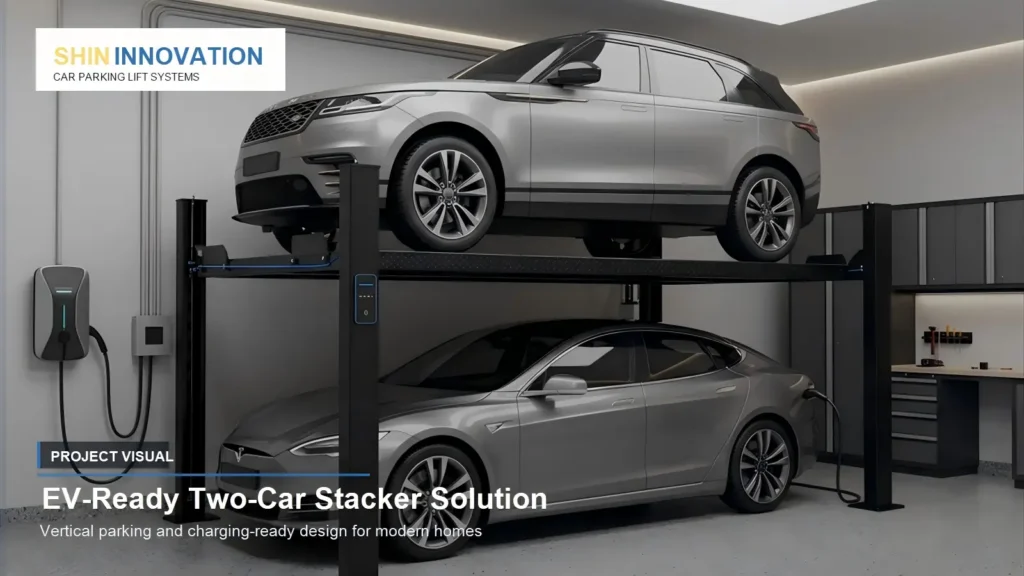
Engineering Consultation
Need an EV-ready parking lift specified for your project?
Our engineering team reviews your ceiling height, slab specification, EV weight loads, and charging integration requirements to recommend the correct system — at no cost.
Get Engineering SupportAll specifications referenced in this guide align with internationally recognised standards: EN 1493 (European vehicle lift safety standard), ANSI/ALI ALCTV (North American equivalent published by the Automotive Lift Institute), ISO 9001 quality management certification, and CE Marking compliance.
Related Guides
Found this engineering guide helpful?
Share it with your professional network on LinkedIn to help others optimize their parking projects.
Share on LinkedIn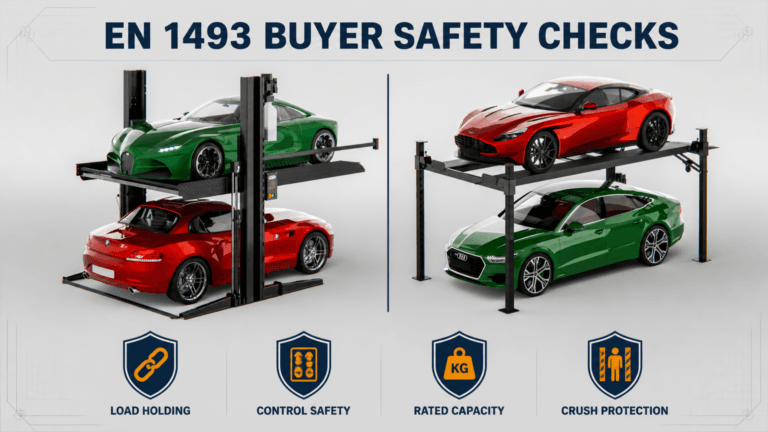


[…] Residential EV-ready car stacker lift — 2026 regulations guide […]
[…] Residential EV-ready car stacker lift — 2026 regulations guide […]
[…] Alternative Fuel Vehicle Refueling Property Credit (30% of installation cost up to $1,000). See our residential EV-ready car stacker guide for pairing […]
[…] to 2,500 kg / 5.5 m / 1.85 m. EV pickups can require custom 3,000+ kg pallets — see our residential EV-ready car stacker guide for the 2026 regulatory […]