
This guide covers everything you need to know about how to choose a residential car parking lift &storage lift(complete guide) — from how these systems work to specifications, costs, and selection criteria. It is written for homeowners, developers, and facilities managers evaluating parking solutions for the first time or upgrading an existing installation.
Understanding the How to Choose a Residential Car Parking Lift (Complete Guide)
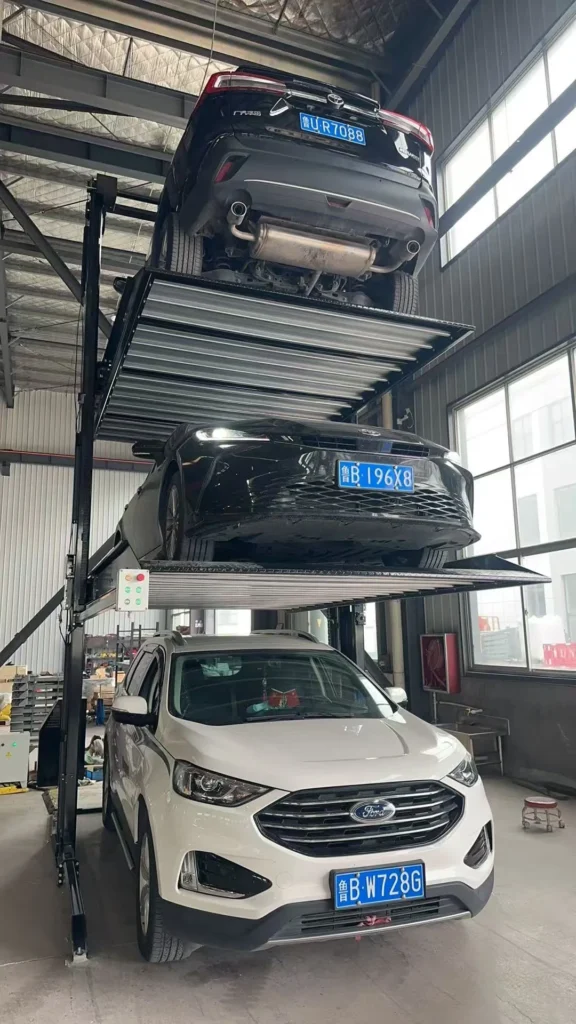
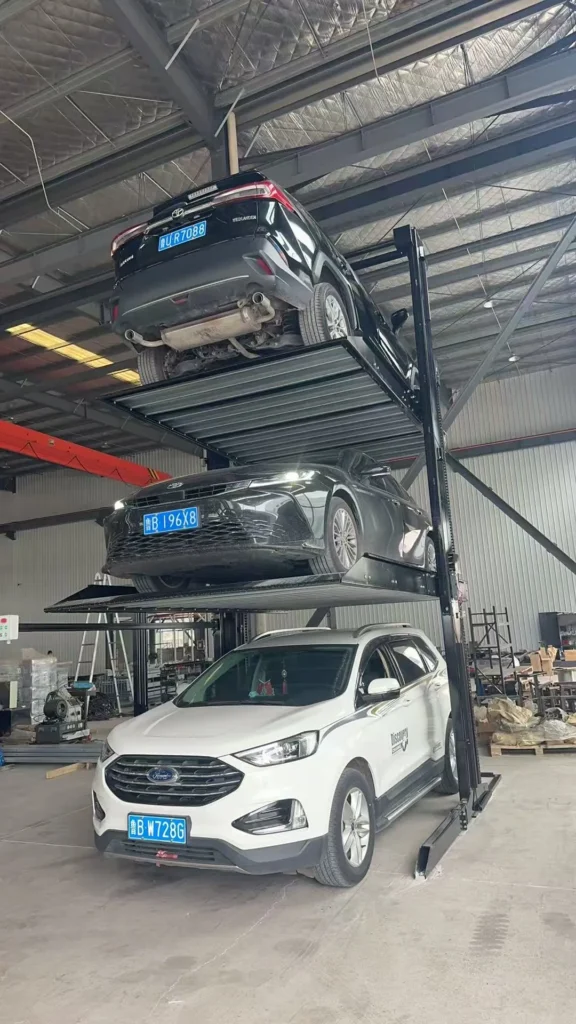
A how to choose a residential storage lift (complete guide) is a mechanically engineered parking system designed to maximise the number of vehicles stored within a fixed footprint. Unlike conventional parking structures, these systems use vertical space — allowing one vehicle to be stored above another, or multiple vehicles to share a bay that would otherwise accommodate only one.
The underlying technology has been refined over four decades. Today’s residential and commercial systems combine hydraulic precision, microprocessor-controlled safety sequences, and structural engineering standards that meet EN 1493, CE Marking, and equivalent international certifications. The result is a system that is not only space-efficient but demonstrably reliable over a 20+ year service life.
How It Works: Technical Overview
Most how to choose a residential car stacker(complete guide) systems operate on one of two drive principles: hydraulic (a power unit pressurises fluid to actuate cylinders) or electro-mechanical (a motor-driven screw or chain mechanism raises and lowers the platform). Hydraulic systems dominate the residential segment due to their smooth operation and high force-to-size ratio. Electro-mechanical designs are common in commercial multi-level applications where simultaneous multi-platform operation is required.
In both cases, the sequence is: vehicle drives onto platform → operator presses control → platform rises to programmed height → automatic mechanical locks engage at the raised position. Descent reverses the sequence, with locks disengaging only after the hydraulic or mechanical system confirms the vehicle weight is supported by the drive mechanism.
Comparison: Key Decision Factors
The table below summarises the primary specifications that distinguish how to choose a residential car parking lift (complete guide) configurations from one another and from conventional parking alternatives:
| Factor | How to Choose a Residential Car Parking Lift (Complete Guide) | Conventional Parking | Multi-Storey Construction |
|---|---|---|---|
| Space efficiency | 2x–4x improvement | Baseline | 2x–6x (at scale) |
| Capital cost per space | $8,000–$22,000 | $5,000–$15,000 | $25,000–$45,000+ |
| Installation time | 1–5 days | N/A | 6–18 months |
| Planning permission | Usually not required | Varies | Always required |
| Maintenance cost/year | $150–$400 | Minimal | $500–$2,000/space |
| EV charging compatible | Yes (optional) | Yes | Yes (at cost) |
Specification Requirements
Structural Prerequisites
The installation surface must be a reinforced concrete slab of minimum 150 mm thickness, designed to carry the point loads specified by the lift manufacturer — typically 30–50 kN per anchor point. If your existing slab does not meet this specification, a structural engineer can advise on options ranging from slab reinforcement to localised pile caps beneath the anchor positions.
Electrical Supply
Single-phase 240V/32A or three-phase 415V/16A, depending on the power unit specification. A dedicated circuit with appropriate isolation is required. If EV charging is integrated, account for the additional load (typically 7.4 kW per charging outlet) in the circuit design.
Ceiling Height
The minimum clear ceiling height depends on the height of the tallest vehicle to be parked in the upper position, plus the platform travel distance, plus a safety clearance of 200 mm. For a typical configuration storing a sedan above an SUV, a 4.5 m clear ceiling height is the standard minimum. Systems for ceiling heights as low as 3.8 m are available in pit-type or low-profile configurations.
Safety Standards and Compliance
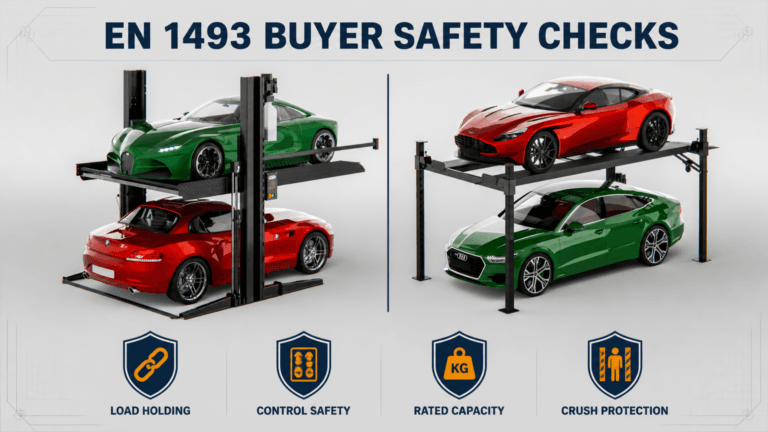
Compliant how to choose a residential car parking lift (complete guide) systems are manufactured to EN 1493 (Europe), ANSI/ALI ALCTV (North America), or equivalent national standards. The non-negotiable safety features are: automatic mechanical locking at the raised position, anti-drop valves on every hydraulic cylinder, overload protection that prevents lifting beyond rated capacity, and descent safety stops that halt movement if an obstruction is detected below the platform.
Annual inspection by an accredited engineer is recommended as a minimum. Many property insurers now require documented annual inspections as a condition of coverage for mechanical parking installations. Retain inspection records for the life of the installation.
Selecting the Right System for Your Project
The three variables that most directly determine the correct system specification are: (1) the ceiling height of the installation space, (2) the weight and dimensions of the heaviest vehicle to be stored in the upper position, and (3) the frequency of use. High-frequency commercial applications — more than 20 cycles per day — warrant a more robust power unit specification and more frequent service intervals than residential installations averaging 2–4 cycles per day.
Where multiple vehicles of varying heights are involved, request a full lifting cycle simulation from the manufacturer, confirming clearances for each vehicle combination. This step is frequently skipped and is the most common cause of post-installation clearance issues.
All specifications referenced in this guide align with internationally recognised standards: EN 1493 (European vehicle lift safety standard), ANSI/ALI ALCTV (North American equivalent published by the Automotive Lift Institute), ISO 9001 quality management certification, and CE Marking compliance — independent third-party assurance that every product meets its stated performance requirements.
Engineering Consultation
Need help specifying the right how to choose a residential car parking lift (complete guide)?
Our engineering team reviews your ceiling height, slab specification, vehicle weights, and usage requirements to recommend the correct system — at no cost.
Get Engineering Support