

Puzzle and combi lift car parking systems are the workhorse of mid-density commercial parking — the mechanical automation category that sits between a simple 2-post stacker and a full vertical parking tower. They move cars horizontally and vertically along a grid of independent pallets, letting an operator retrieve any vehicle in 45–90 seconds while multiplying capacity 2–5x within the same footprint. This guide covers what a puzzle system actually is, how it differs from combi lifts, the chain-vs-wire-rope decision that shapes maintenance cost, and how to specify one for a hotel, dealership, or multi-family project.
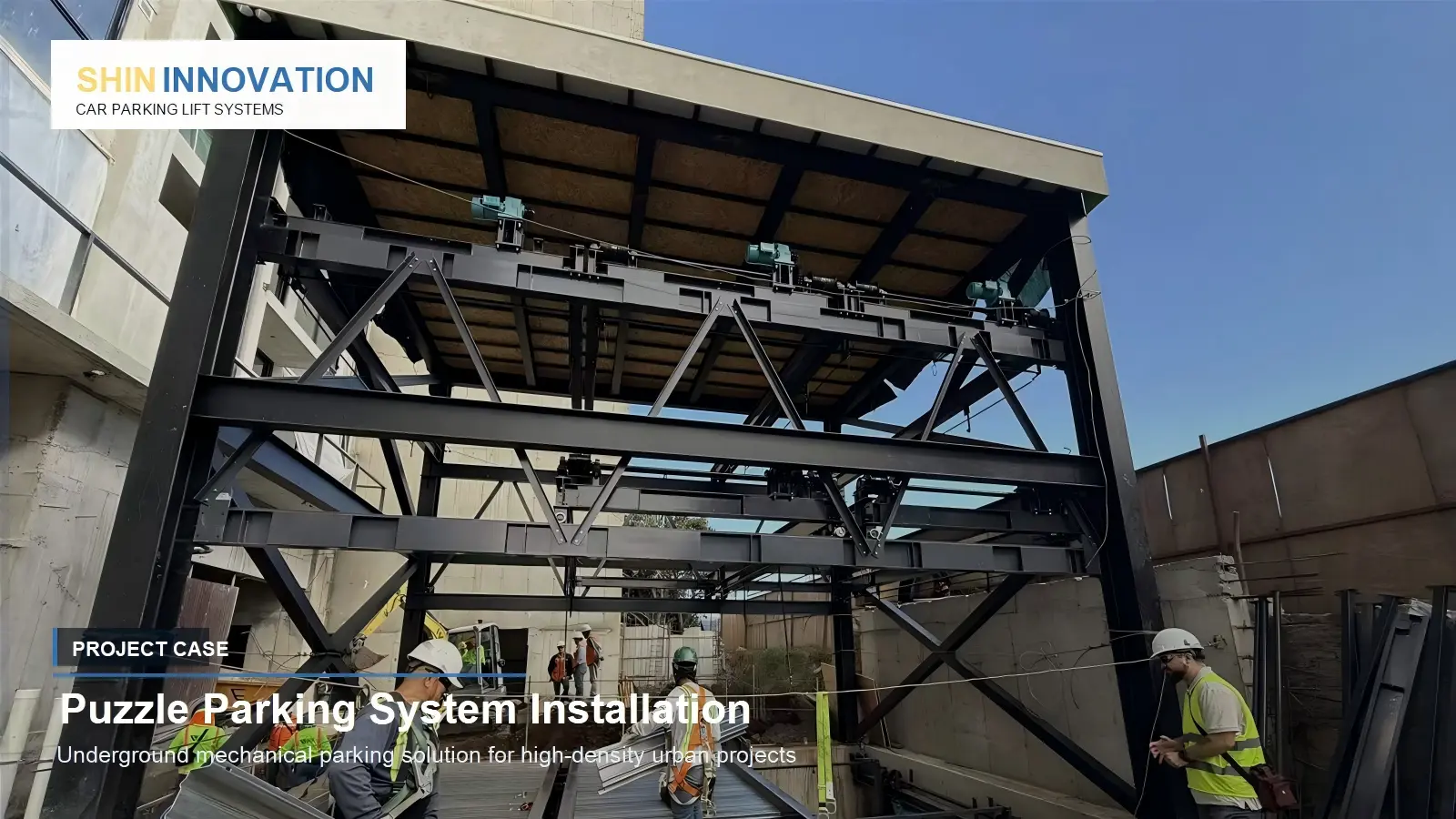
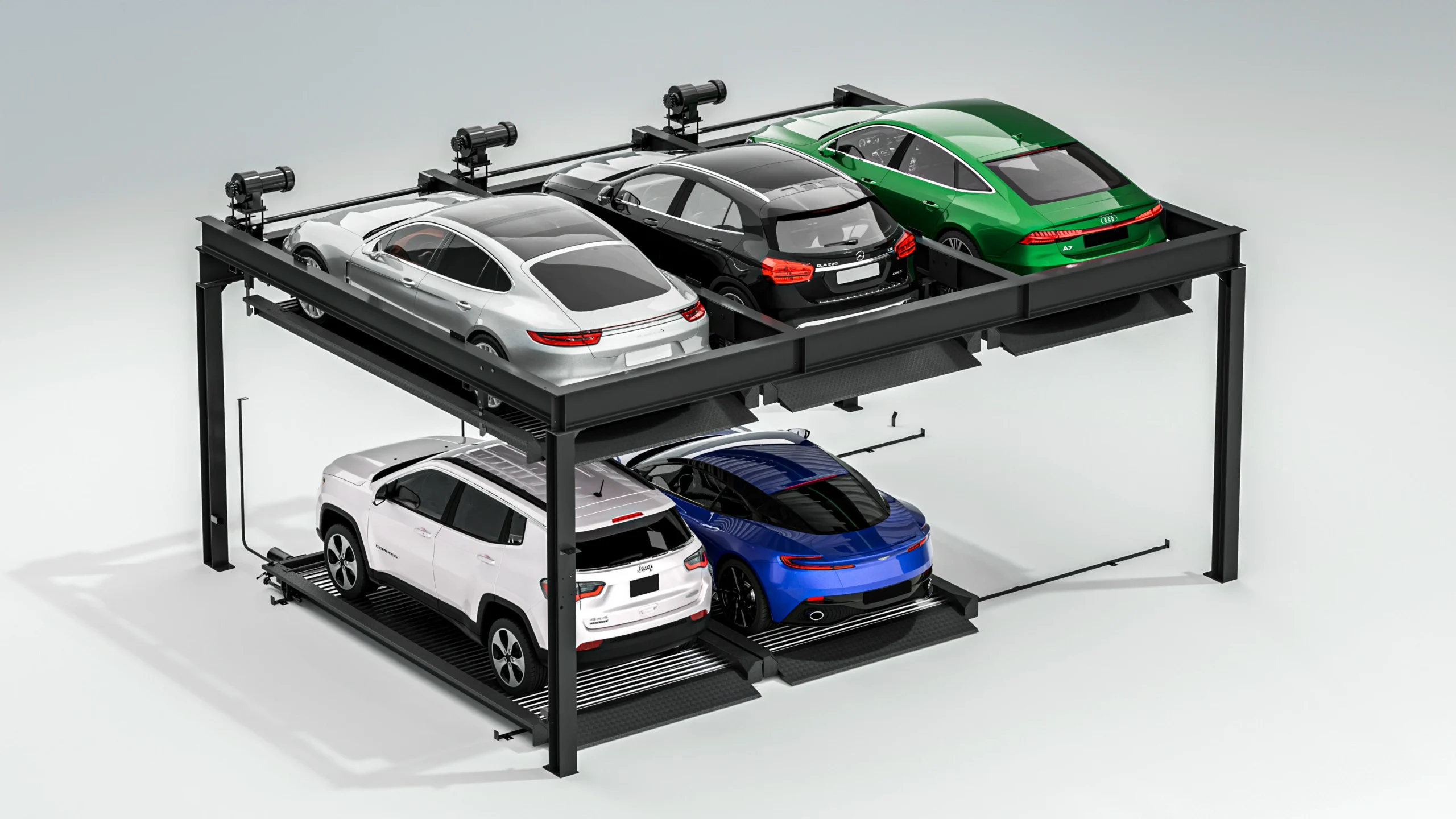
Puzzle vs Combi Lift: Definitions That Matter
The industry uses the terms interchangeably in casual conversation, but the mechanical distinction is real and affects both capital cost and operating logic.
| System type | How it works | Ground-floor requirement | Typical capacity |
|---|---|---|---|
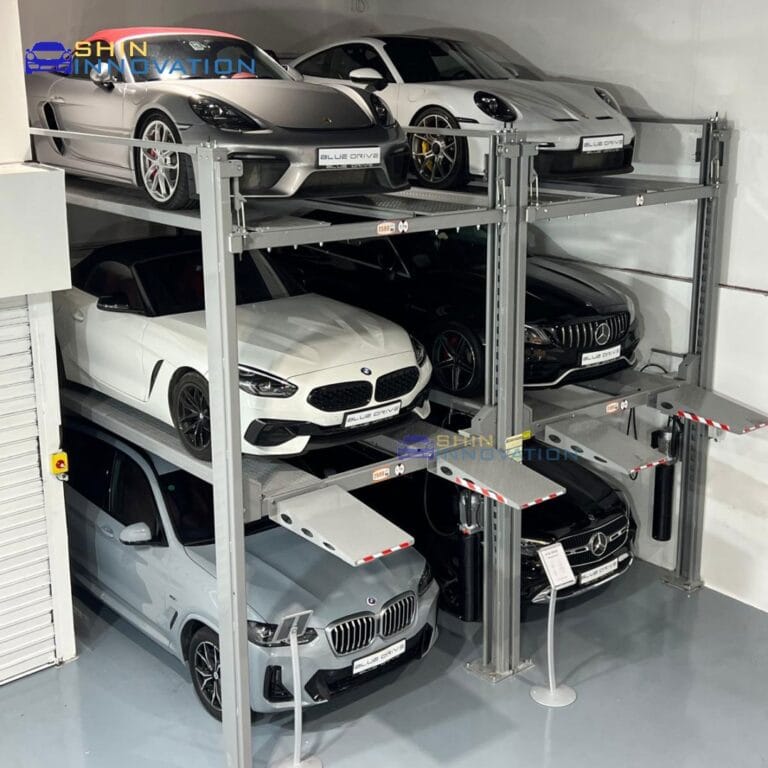
| Puzzle parking system | Multiple pallets on 2–7 levels; one open slot on the ground floor at all times. Pallets shuffle horizontally and vertically like a 15-piece sliding puzzle to bring the requested vehicle to the entry point. | 1 open slot per column always empty | 6–40 vehicles per module |
| Combi lift (parallel type) | Independent lifting columns per bay; each vehicle can be retrieved without moving neighbouring pallets. Combines the drive-on convenience of a stacker with the density of a puzzle. | No sacrificial slot required | 4–18 vehicles per module |
| Combi lift (pit type) | Adds an underground level so the parked-below pallet is invisible at ground level, restoring visual openness of the site. | Pit excavation 1.7–2.2 m | 6–24 vehicles per module |
For a boutique hotel needing quick valet turnover during check-in rush hour, a combi lift is worth the premium. For a residential development where cars sit parked overnight and are retrieved once a day, a puzzle system delivers the lowest cost per stall.
The Chain vs Wire Rope Decision (This Matters More Than You Think)
Every puzzle or combi lift raises its pallets using either roller chain or wire rope. The choice sets maintenance intervals for the next 15–20 years and is often decided by procurement without any input from the operations team. Get it wrong and you either pay for premature replacement or accept 2x the annual downtime.
Chain lifting puzzle parking system
- Mechanism: Duplex or triplex roller chain driven by a geared motor, running over sprockets at the top of each column. Load transfers through steel links in shear.
- Maintenance cycle: Lubrication every 6 months, chain tension check annually, replacement at 50,000–80,000 cycles (typically 12–18 years at residential duty).
- Noise: 65–72 dB at 1 m during travel — noticeable in residential buildings if the shaft is not acoustically isolated.
- Failure mode: Graceful. Chains stretch progressively and give visible warning before failure; the pallet does not free-fall even under a broken link because of redundant safety pawls.
- Best for: High-cycle commercial applications (hotels, dealerships), climates with high humidity where wire rope corrosion is a concern.
Wire rope lifting puzzle parking system
- Mechanism: Galvanised or stainless steel wire rope (typically 6×19 or 8×19 construction) wound on a grooved drum, running over sheaves. Load transfers through rope tension.
- Maintenance cycle: Visual inspection every 3 months, lubrication annually, replacement at 30,000–50,000 cycles (typically 8–12 years at residential duty).
- Noise: 55–62 dB — noticeably quieter, ideal for residential-adjacent installations.
- Failure mode: Requires vigilant inspection. Wire rope fatigue shows as broken wires within the rope’s outer strands and can progress quickly if missed. Reference: ASME B30.7 for inspection criteria applicable to lifting-rope drums.
- Best for: Residential and mixed-use buildings where noise limits apply, dry climates where corrosion is controllable, sites with skilled maintenance staff.
Neither is universally better. The right answer depends on cycle rate, noise sensitivity, and the availability of local service capability — ShinInnovation supplies both formats and provides operating-condition assessment before recommending one.
Where Puzzle & Combi Systems Beat Traditional Parking
| Project type | Traditional multi-storey concrete | Puzzle / combi mechanical | Density gain |
|---|---|---|---|
| Small hotel (25 rooms) | 18–22 stalls in 550 m2 | 32–40 stalls in 200 m2 | +80% stalls, −64% footprint |
| Residential mid-rise (60 units) | 60 stalls across 2 basement levels | 60 stalls in one puzzle bay, no basement | Eliminate 1 basement level |
| Urban car dealership | 15 display + 25 storage stalls | 15 display + 60 puzzle-stored stalls | +140% inventory capacity |
| Corporate office (200 employees) | 90 stalls in 4-storey deck | 140 stalls in same envelope | +56% stalls, no vertical expansion |
The financial case is usually decisive. A multi-storey concrete parking deck costs USD 25,000–45,000 per stall built (2026 North American market). A puzzle mechanical system delivers the same capacity at USD 6,000–10,000 per stall installed, and it can be relocated or removed if the property is later redeveloped — something a concrete deck cannot offer. See our detailed ROI analysis: stackable car parking vs multi-storey construction for the full 30-year TCO model.
Specification Checklist for Buyers
- Vehicle mix: Confirm the largest vehicle you need to accommodate. Standard pallets handle up to 2,000 kg / 5.3 m length / 1.55 m height. SUV pallets extend to 2,500 kg / 5.5 m / 1.85 m. EV pickups can require custom 3,000+ kg pallets — see our residential EV-ready car stacker guide for the 2026 regulatory outlook.
- Cycle time budget: Puzzle systems retrieve in 45–90 seconds depending on the requested vehicle’s position. Combi lifts retrieve in 20–30 seconds regardless of position. If you have simultaneous multi-user demand (hotel check-out rush), specify a combi.
- Ground floor requirements: Puzzle systems need one always-empty slot per column. Verify your capacity math includes this sacrificial slot — a “36-car puzzle” in a 3-column layout gives you 33 usable stalls.
- Overhead clearance: Standard puzzle systems require 5.4–7.2 m clear height depending on level count. Combi lifts need 3.6–4.2 m per pair. Both formats accept custom sizing for low-ceiling retrofits.
- Slab strength: Column base loads run 40–80 kN each. Standard 100 mm 3,000 PSI slabs are adequate for residential-scale puzzles; commercial-scale systems typically need engineered pad footings. Verify per our car stacker lift concrete floor specs guide.
- Fire safety: Reference NFPA 88A for parking structure fire protection. Enclosed mechanical parking may require ventilation and sprinkler modifications — confirm with your local AHJ during design.
- Power supply: Puzzle systems draw 3–7 kW during travel; combi lifts 5–15 kW. Confirm 3-phase 380/415 V supply availability.
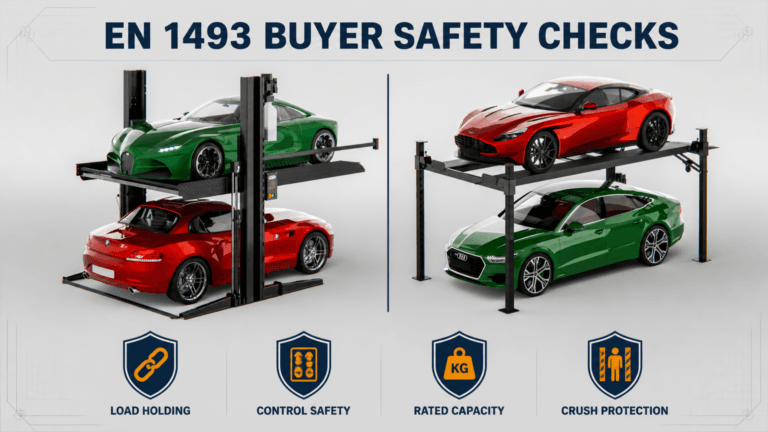
- Certification: European deployments require CE marking and EN 14010 compliance. North American deployments should reference ANSI/ALI ALCTV where applicable.
Common Buyer Mistakes
- Undersizing for EV weight growth. EV pickup trucks routinely exceed 3,000 kg. Systems specified in 2020 with 2,000 kg pallets are now refusing to lift customer vehicles. Always spec at least 20% weight headroom above current typical vehicles.
- Skipping the sacrificial slot count. Marketing materials quote pallet count; usable stall count is 1–3 less depending on layout. Ask for both numbers on every quote.
- Assuming chain is always cheaper. Wire rope systems cost 5–10% less at purchase but replace 30–50% more often. Over 20 years, chain systems win on total lifetime cost.
- No maintenance budget line. Puzzle and combi systems require USD 800–2,500 per module per year in inspection, lubrication, and wear parts. Buyers who treat these as “install and forget” experience 3x higher downtime.
Related Buying Guides
- Is a car parking lift worth it? Cost, benefits & ROI
- ROI analysis: stackable car parking vs multi-storey construction
- 2 post car parking lift — residential applications
- 4 post car parking lift — drive-on flexibility & buying tips
- Car stacker lift concrete floor specs (4-inch, 3,000-PSI rule)
- Home car stacker buying guide — how to choose the right lift
ShinInnovation designs and manufactures puzzle and combi lift parking systems for hotels, dealerships, and multi-family developments across Europe, North America, and Southeast Asia. For a project-specific configuration — including pallet sizing for EV vehicles, chain vs wire rope selection, and CE-compliant safety documentation — contact our engineering team at shincarlift.com/contact.


[…] of vehicles stored within a fixed footprint which the main model is Roraty parking system and Puzzle parking system. Unlike conventional parking structures, these systems use vertical space — allowing one vehicle […]
[…] use a hydraulic-driven system supported by heavy-duty steel chains or cables — and the choice of chain vs wire-rope drive affects maintenance and noise. The hydraulic cylinder provides the lifting force, while the […]