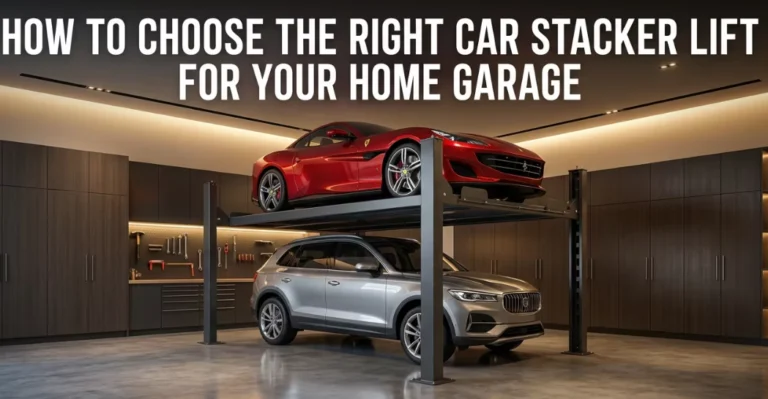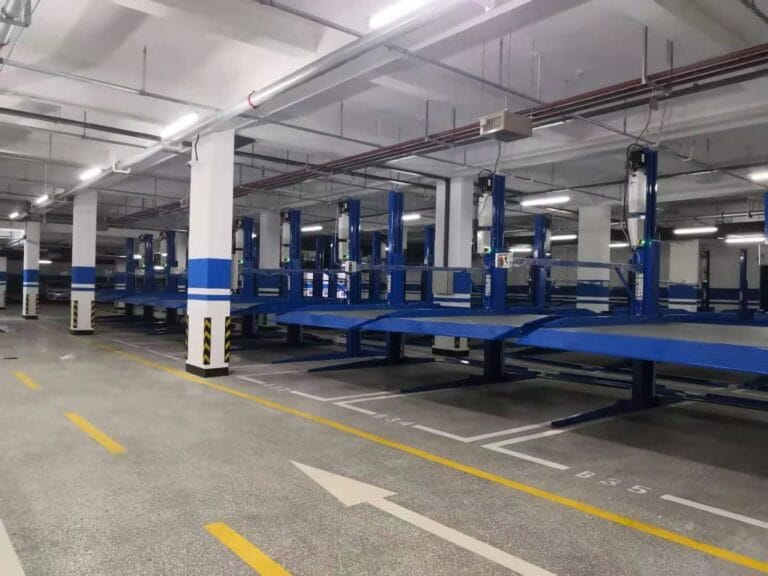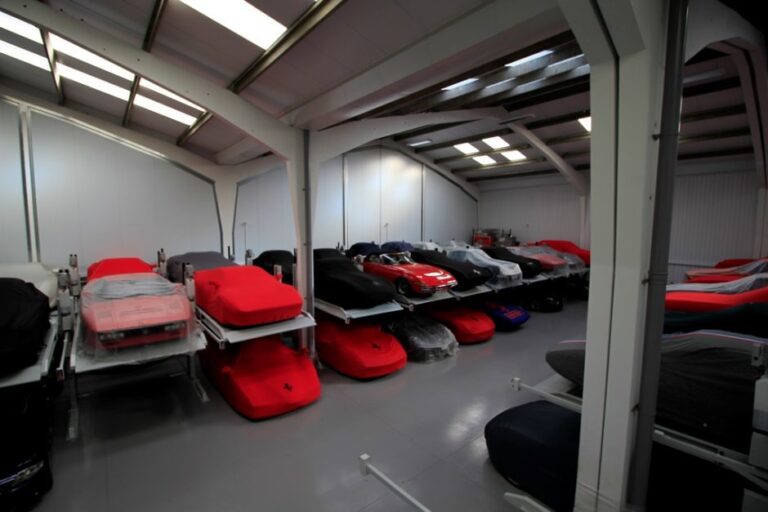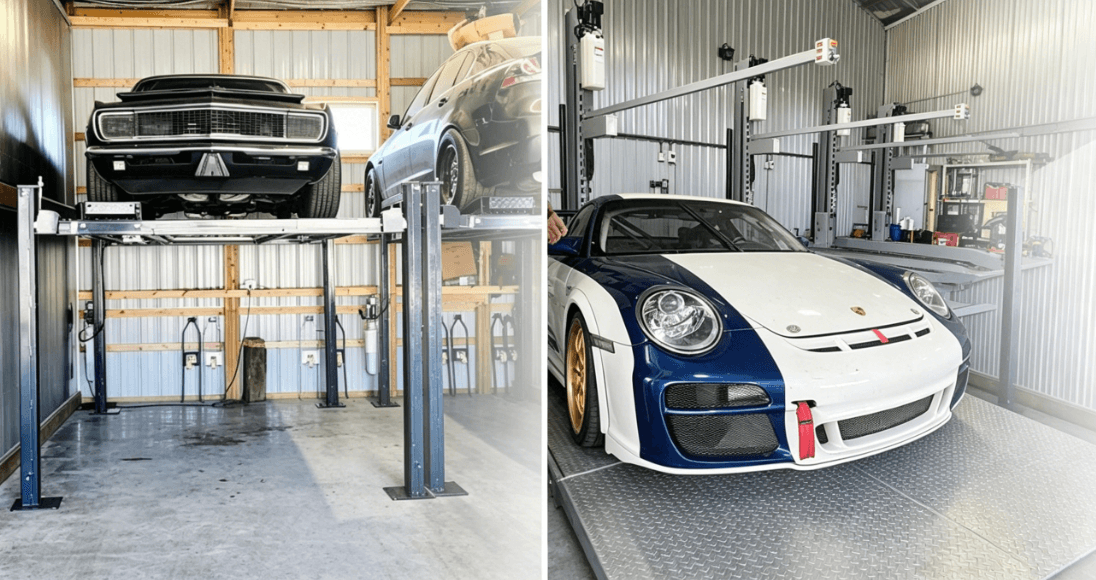

If you’re looking to double your parking space or store a classic car safely, choosing between a 2-post parking lift and a 4-post car stacker is the most critical decision you’ll make. As urban living spaces shrink and car collections grow, vertical parking has shifted from a luxury to a necessity. However, picking the wrong type of lift can lead to installation headaches and operational frustration. In this expert guide, we’ll dive deep into the mechanics, space requirements, and safety features of both solutions to help you make an informed investment.https://shincarlift.com/equipment/two-post-parking-lift/
1. 2-Post Parking Lifts: The Space-Saving Specialist
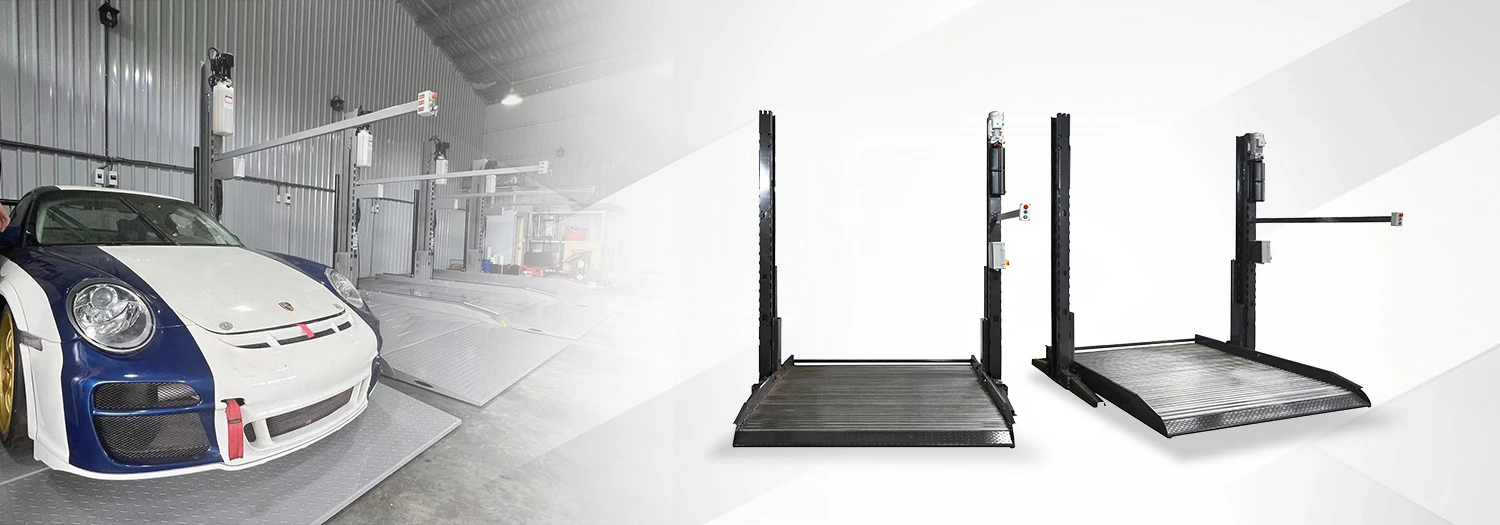
The 2-post parking lift (like our professional PTP series) is engineered for efficiency. Unlike service lifts used in mechanic shops, parking-specific 2-post lifts feature a solid platform that prevents fluids from the top vehicle from dripping onto the one below. Its primary advantage is its footprint. Because it only has two vertical columns, it offers a wider drive-through clearance, making it much easier to open car doors while parked.
One of our signature technologies is the Shared Post Design. For commercial projects or multi-car garages, our 2-post lifts can “share” a middle post. This allows you to install 10 lifts using only 11 posts instead of 20, significantly saving both space and cost. This is best for compact residential garages, narrow driveways, and modern car collections where every inch of floor width counts.
2. 4-Post Parking Lifts: The Gold Standard for Stability
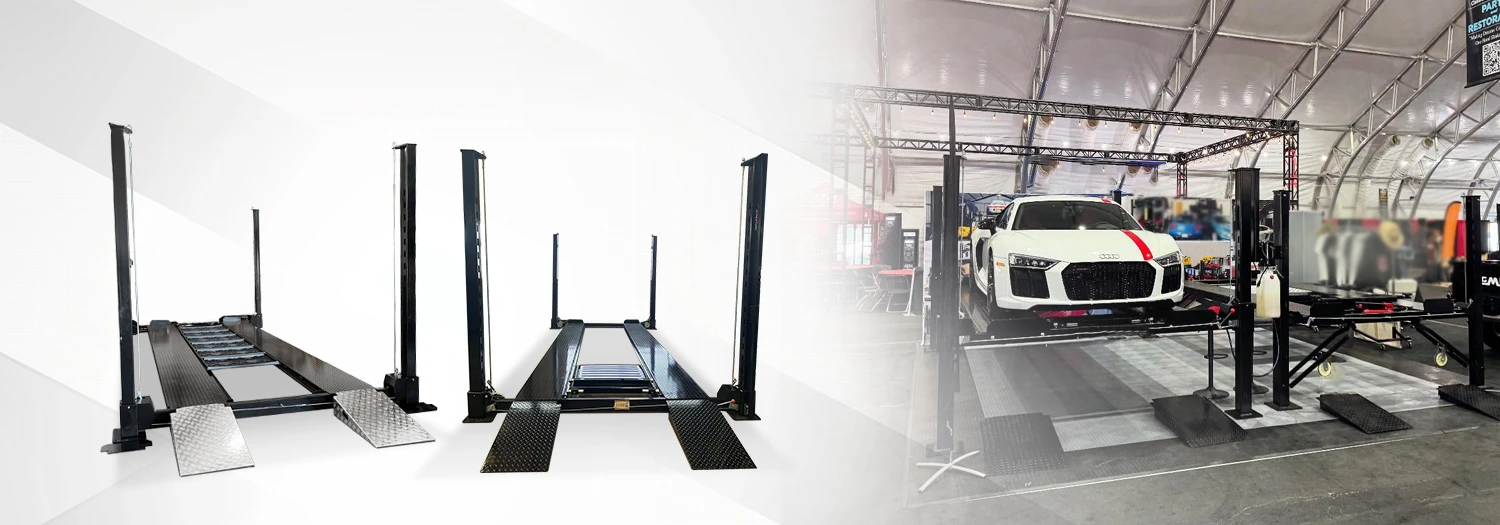
If security and versatility are your priorities, the 4-post car lift is the ultimate choice. These lifts distribute the vehicle’s weight across four heavy-duty steel columns, making them the most stable lifting platforms available. They are often preferred by owners of high-value classic cars or heavy electric SUVs. Many 4-post models do not require permanent anchoring to the floor, making them a more flexible option for temporary or leased spaces.
Our 4-post technology also extends to Triple Stackers (storing 3 cars in the space of 1), providing the highest density parking solution for commercial developments. The full-width runways make it incredibly simple to drive on and off without the precision required by some 2-post systems, making it totally foolproof for beginners.
Related Buying Guides
- 2 post car parking lift — pros, cons & residential applications
- 4 post car parking lift — drive-on flexibility & buying tips
- How to choose the right car stacker lift for your home garage
- Is a car parking lift worth it? Cost, benefits & ROI
- Car stacker lift concrete floor specs — the 4-inch, 3,000-PSI rule
- Puzzle & combi lift car parking systems buyer’s guide
2026 Comparison: Which Lift Fits Your Goal?
| Feature | 2-Post Parking Lift (PTP) | 4-Post Parking Lift (PFPS) |
|---|---|---|
| Primary Use | Narrow garages / Daily use | Storage / Heavy SUVs |
| Footprint | Compact (Shared post available) | Large (Maximum stability) |
| Installation | Deep concrete anchoring required | Often freestanding/bolt-down |
| Ease of Entry | High (Open doors easily) | Moderate (Navigate posts) |
| Capacity | 2,000kg – 2,500kg | 2,700kg – 5,000kg+ |
| Best For | Space optimization | Vehicle preservation |
3. Technical Planning: Factors to Consider Before Buying
Before you hit the “buy” button, you must evaluate three critical environmental factors in your garage to ensure a safe and smooth installation.
A. Ceiling Height & Vehicle Clearance
This is where most mistakes happen. You must calculate the height of both vehicles plus the platform thickness (usually 4-6 inches) and a safety buffer of at least 6 inches for the locking mechanism to engage. For most 2-stacker systems, a minimum ceiling height of 10-12 feet is required. We recommend using the formula: Vehicle 1 Height + Vehicle 2 Height + 10 Inches = Minimum Ceiling Height.
B. Concrete Foundation Strength (PSI)
A 2-post lift exerts a high amount of “tipping” force on the floor. Therefore, a reinforced concrete slab of at least 6 inches (3000 PSI) is typically required. 4-post lifts are more forgiving but still require a level, solid surface. Always check your local building codes for concrete specifications before installation.
C. Power Units & Voltage Customization
Most residential lifts run on standard 220V single-phase power, but commercial-grade automatic systems may require 380V three-phase power. At ShinInnovation, we customize our hydraulic power units (HPU) to match your local voltage and frequency (50Hz/60Hz), ensuring your lift operates flawlessly anywhere in the world.
4. Why Global Buyers Trust ShinInnovation
As a professional manufacturer with decades of export experience, Qingdao ShinInnovation Technology understands that a parking lift is a life-long investment. We refuse to cut corners on material thickness or hydraulic quality. Our equipment complies with BS EN 14010 and EN 1493 standards, ensuring peace of mind for buyers in Europe, the Middle East, and beyond.
Every lift features advanced safety systems including automatic safety locks inside post holes, emergency stop buttons, and hydraulic burst protection valves. By eliminating the middleman, we provide premium industrial-grade equipment at highly competitive factory prices.
Conclusion: Start Your Parking Transformation Today
Choosing the right lift isn’t just about price; it’s about matching the technology to your specific space and vehicle needs. Whether you need a simple 2-post stacker for your home garage or a complex automated parking system for a commercial project, our team is here to guide you. We provide free technical drawings and custom layout designs to ensure your project lands smoothly.
2 Post Lift vs 4 Post Lift for Home Garage: The 30-Second Answer
For most home garage buyers with standard cars and adequate ceiling height, a 2 post parking lift delivers 80% of the value at 60% of the cost of a 4 post equivalent. For garages storing lifted trucks, low-slung sports cars, or vehicles that will be raised for weeks at a time (car storage rather than routine parking), a 4 post car parking lift is worth its higher footprint and price. Everything below explains why, with the specific decision criteria used by our engineering team.
Best Car Lift: 2 Post vs 4 Post Decision Framework
The “which is the best car lift” question does not have a universal answer — the best format depends on four site-specific factors. Rank each of your priorities on this matrix, and the correct choice usually becomes obvious.
| Priority | 2 Post lift wins if… | 4 Post lift wins if… |
|---|---|---|
| Garage footprint | Under 3.5 m wide bay; every m2 matters | Bay is 3.5 m+ wide; footprint less critical |
| Vehicle mix | Standard sedans and SUVs only; consistent lifting points | Sports cars, lifted trucks, unibody EVs, mixed profiles |
| Duty cycle | Daily up-down (routine parking) | Long-term storage (weeks/months raised) |
| Budget | USD 4,600–7,800 installed target | USD 5,900–9,900 installed budget available |
| Installation time | 1 working day preferred | 1.5–2 working days acceptable |
Two out of three “wins” on the same side is usually a decisive signal. See the deeper analysis in our full 2 post car parking lift guide and 4 post car parking lift guide for the format-specific detail behind each row.
Two Post Parking Lift: When Compact Beats Everything
A two post parking lift uses only two vertical columns flanking the vehicle, with swing arms engaging OEM lifting points beneath the chassis. There is no upper platform — the raised car is suspended in mid-air, freeing the entire ground area for a second vehicle. That single design choice delivers three advantages that no 4 post system can match:
- Smallest concrete footprint of any residential lift category — typically 3.0 m × 2.8 m per bay, versus 3.2 m × 5.5 m for a comparable 4 post format.
- Fastest installation — a trained crew commissions a 2 post lift in one working day; a 4 post takes 1.5–2 days.
- Lowest total cost of ownership — USD 843 per parked-car-year over 5 years, versus USD 1,019 for 4 post (see our ROI analysis for the full calculation).
The trade-off: a two post lift only accepts vehicles with clean, accessible chassis lifting points. If you own a low-slung sports car, a heavily-modified pickup, or a unibody EV where lifting points are obscured, a 2 post will not work safely regardless of its footprint advantage.
Ceiling Height & Slab Requirements (Both Formats)
Regardless of which format you pick, both 2 post and 4 post car parking lifts share the same non-negotiable site requirements. Before ordering, verify:
- Minimum clear ceiling height: 3.8 m (12.5 ft) for a 2 post stacker; 4.0 m (13.1 ft) for a 4 post stacker. Add 20 cm if either upper or lower vehicle is a full-size SUV or pickup.
- Concrete floor: Minimum 100 mm (4 inches) reinforced slab at 3,000 PSI compressive strength. See our dedicated car stacker lift concrete floor specs guide for the ACI 318-19 verification steps.
- Dedicated 220V – 240V / 20A circuit within 3 m of the lift location.
- Garage door clearance: Verify tracks and openers do not interfere with the raised platform on either format.