
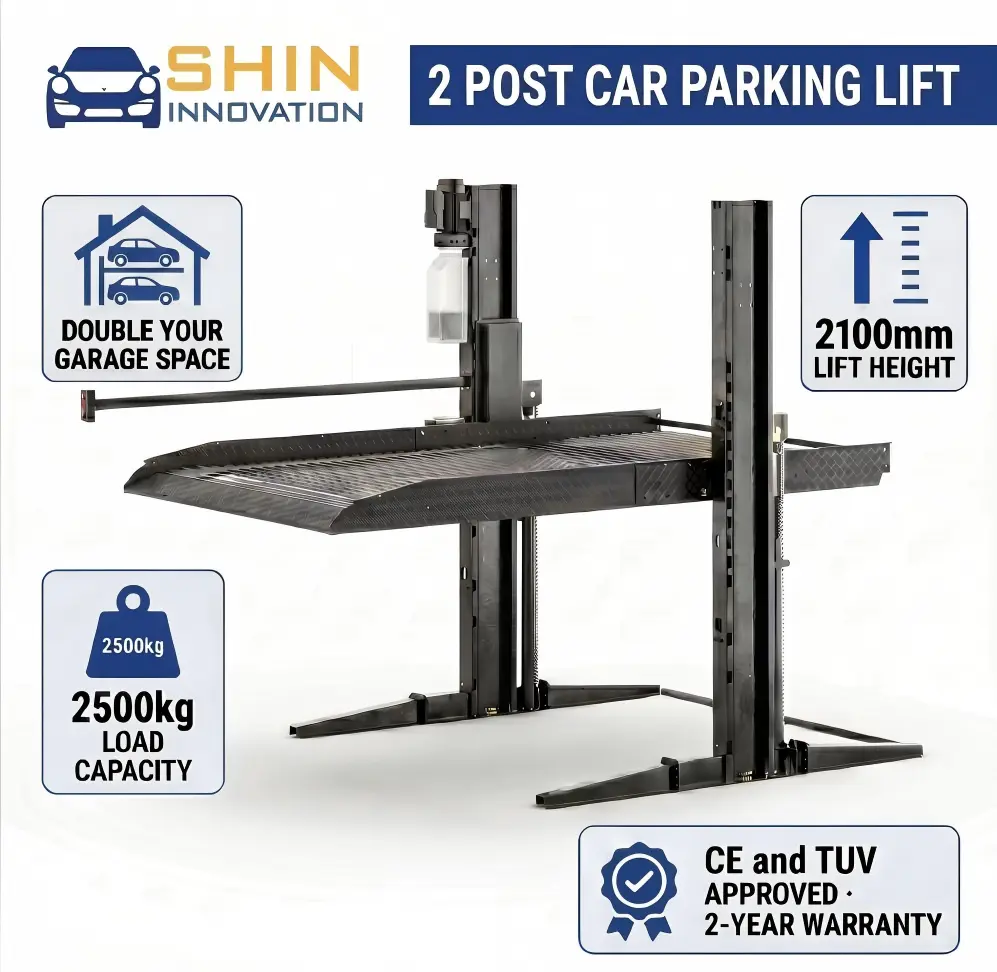

This guide focuses on a platform-based two post parking lift for vehicle parking and storage. Do not confuse it with an arm-type service lift: the two designs support vehicles differently and may have different permitted uses. Check the exact model rather than choosing equipment by the number of posts alone.Two Post Parking Lift
Before comparing quotations, establish the vehicles to be stored, the required access pattern and the available installation space. The following checks help you evaluate the advantages and limitations of a proposed parking configuration without assuming that every two-post model works in the same way.
Understanding the 2 Post Car Parking Lift
This guide discusses platform-based parking lifts. An arm-type service lift supports a vehicle at designated chassis lifting points and should not be treated as interchangeable with parking equipment. Confirm the permitted use, vehicle limits and operating procedure for the exact model before ordering. Compare the footprint and installation requirements of the specific models under consideration.
How It Works: Technical Overview
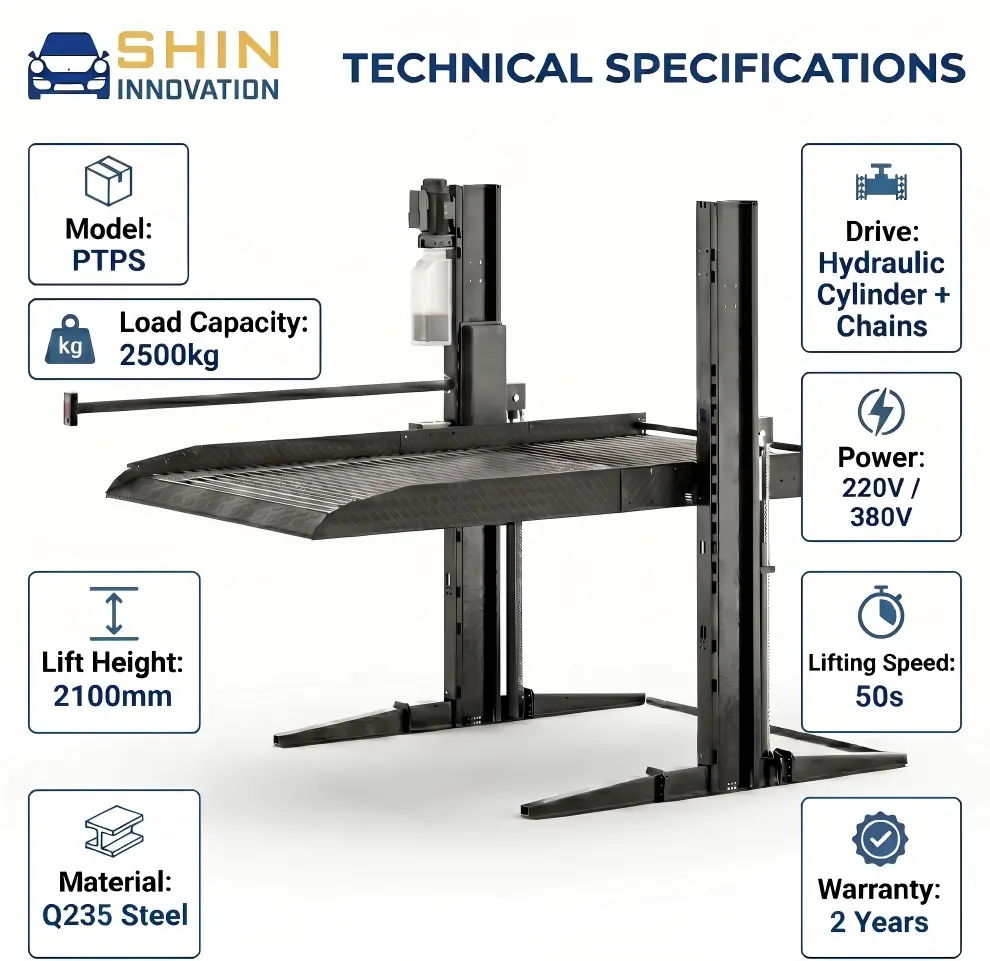
A proposed lift may use a hydraulic or electro-mechanical drive. Identify the drive arrangement from the selected model documentation rather than assuming the same configuration for every two-post lift.
Follow the model-specific operating and emergency instructions. Confirm vehicle support, the parked-position holding method and the documented checks before operation; this overview is not an operating sequence.
2 Post Parking Lift: Advantages and Trade-Offs
| Potential advantage | What to verify before purchase |
|---|---|
| Additional parking within a constrained layout | Confirm the complete installed footprint, usable platform area and vehicle clearances on the model drawing. |
| A configuration suited to a specific vehicle pair | Check the weight, dimensions, wheel positions and permitted loading for both vehicles. |
| An alternative to a different parking arrangement | Compare quotations with the same installation scope and number of usable spaces. |
Limitations That Can Affect Daily Use
- Retrieval may depend on moving another vehicle. Confirm the sequence for the exact configuration.
- Columns, anchors, power equipment and overhead obstructions affect the usable layout.
- Inspection, maintenance and emergency procedures remain part of ownership.
- Use for parking does not establish permission to work underneath a vehicle.
For a separate configuration comparison, read the 2 post versus 4 post parking lift guide. Keep the present page focused on whether a two-post parking configuration fits your site.
Specification Requirements
Structural Prerequisites
Use the foundation drawing and anchoring schedule for the selected model. Have the existing slab assessed by the project engineer before installation. The engineer should determine the structural requirements and applicable design standards for the site; a general standards reference is not a substitute for this assessment.
Electrical Supply
Confirm the voltage, phase, frequency and circuit requirements against the selected power unit documentation before arranging the electrical supply. If EV charging is integrated, account for the additional load in the circuit design.
Ceiling Height
Check the selected model’s clearance drawing against both vehicles and any overhead obstructions. Ask the project engineer to confirm the available clearance before installation.
Documents to Check for the Selected Model
Request the installation and operating manual, rated vehicle limits, foundation and anchoring drawings, electrical requirements, maintenance instructions and any conformity or test documents applicable to the proposed use and destination.
- Confirm how the vehicle is supported and how the platform is held in its parked position.
- Review clearance requirements for the full operating sequence, not only the final parked position.
- Confirm the operating controls and the documented procedure for a fault or power interruption.
- Establish who is responsible for installation, commissioning, inspection and ongoing service.
Do not treat a quality-management certificate, a general standards link or a statement about another lift type as proof that the selected model meets every local requirement. Have the project engineer and relevant local professionals review the documents before purchase.
Selecting the Right System for Your Project
Evaluate ceiling height, vehicle mass and dimensions, operating pattern and the selected model’s documented limits. Request a model-specific lifting-cycle review where vehicle combinations or frequent operation may affect design.
Check Your Site Before Choosing a Lift
Prepare vehicle dimensions and weights, the proposed layout, available clearances, foundation information and expected operating pattern. For the financial decision, review parking lift costs, benefits and payback.
Request a model-specific engineering review.
Related Buying Guides for Home & Commercial Buyers
Choosing a car stacker is rarely a single-page decision. The guides below cover adjacent topics that most buyers evaluate alongside this one — from format comparison and EV compatibility to price benchmarking and manufacturer selection. Together they form a complete home car stacker buying guide for residential and small-format commercial projects.
- 2 post vs 4 post parking lifts — head-to-head 2026 comparison guide
- 4 post car parking lift — drive-on flexibility & buying tips
- Residential EV-ready car stacker lift — 2026 regulations guide
- BendPak vs ShinInnovation parking lifts — full comparison
- Is a car parking lift worth it? Cost, benefits & ROI
- Home car stacker buying guide — how to choose the right lift


[…] 2 post car parking lift — pros, cons & residential applications […]
[…] formats, and they generate revenue rather than avoiding costs. See the format comparison in our 2 post car parking lift guide and 4 post car parking lift […]
[…] 2 post car parking lift — pros, cons & residential applications […]
[…] 2 post car parking lift — pros, cons & residential applications (space-efficient, arms-based, 2,500–3,500 kg capacity, best for standard home garages) […]
[…] 2 post car parking lift — pros, cons & residential applications […]
[…] For more detailed sizing recommendations, explore the comprehensive 2 post car parking lift guide. […]