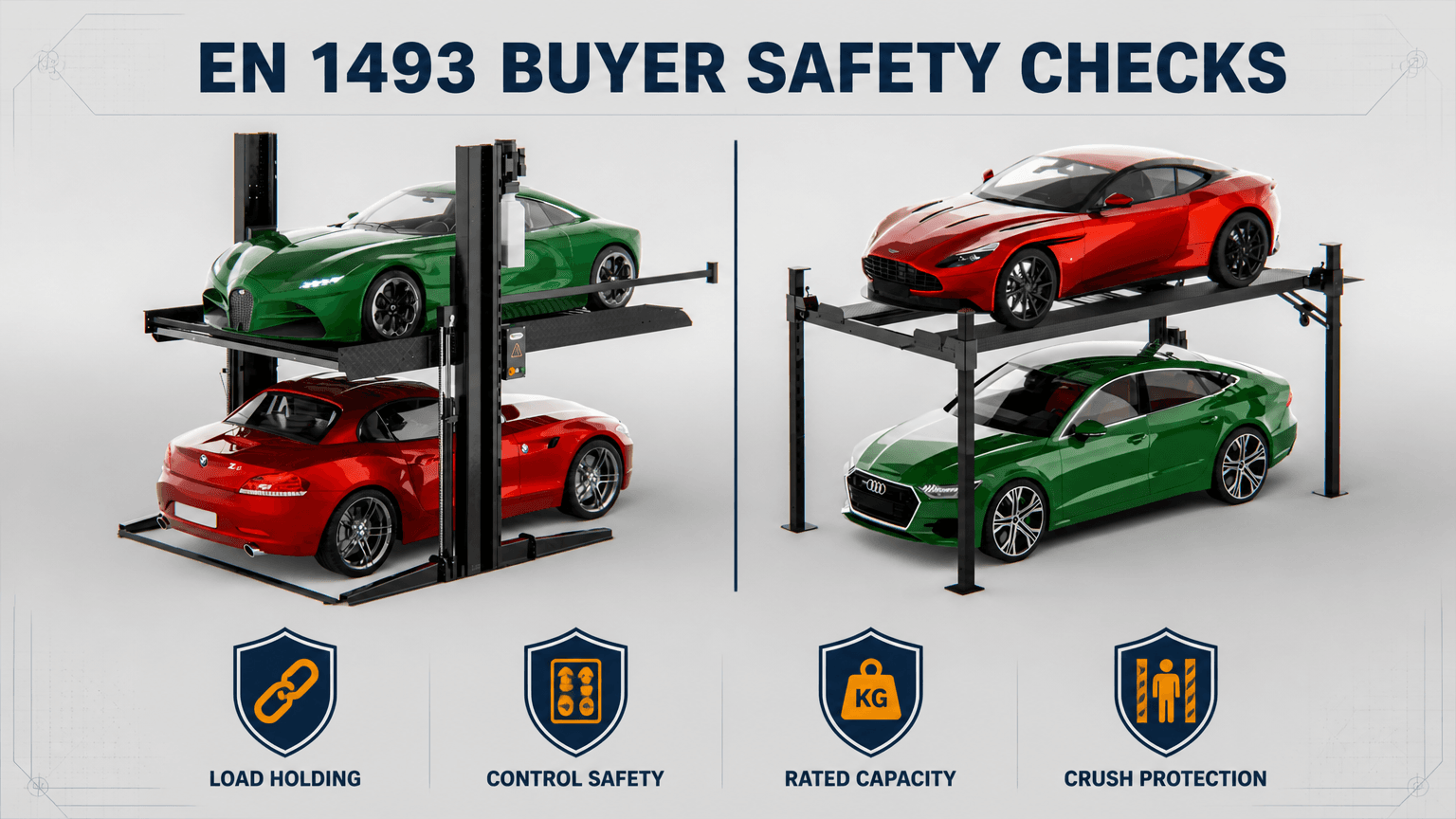
EN 1493 is not a four-item checklist. It is a European vehicle lift safety standard covering design, construction, testing and verification. For parking-lift buyers, however, four functional safety groups provide a practical first-pass review: load holding, controlled movement, overload and structural protection, and protection against crushing or unintended access.
This guide explains those four groups in buyer language. It does not reproduce the copyrighted standard or replace a conformity assessment. Instead, it shows which documents, test evidence and physical mechanisms you should request before approving a two-post or four-post parking lift for a project.
What EN 1493 Covers — and What It Does Not
EN 1493:2010 applies to vehicle lifts and addresses hazards associated with lifting, supporting and lowering vehicles. It sits within a wider compliance framework. A complete European-market assessment may also involve the applicable machinery legislation, electrical requirements, risk assessment, installation conditions and model-specific technical documentation.
Parking equipment can also fall within the scope of EN 14010, depending on the system and its intended operation. That distinction matters: a workshop lift, a dependent parking stacker and a fully automatic parking system are not interchangeable products. A certificate naming a company is therefore insufficient. The declaration and test evidence must identify the actual model and applicable standards.
Safety Group 1: Load Holding and Protection Against Uncontrolled Descent
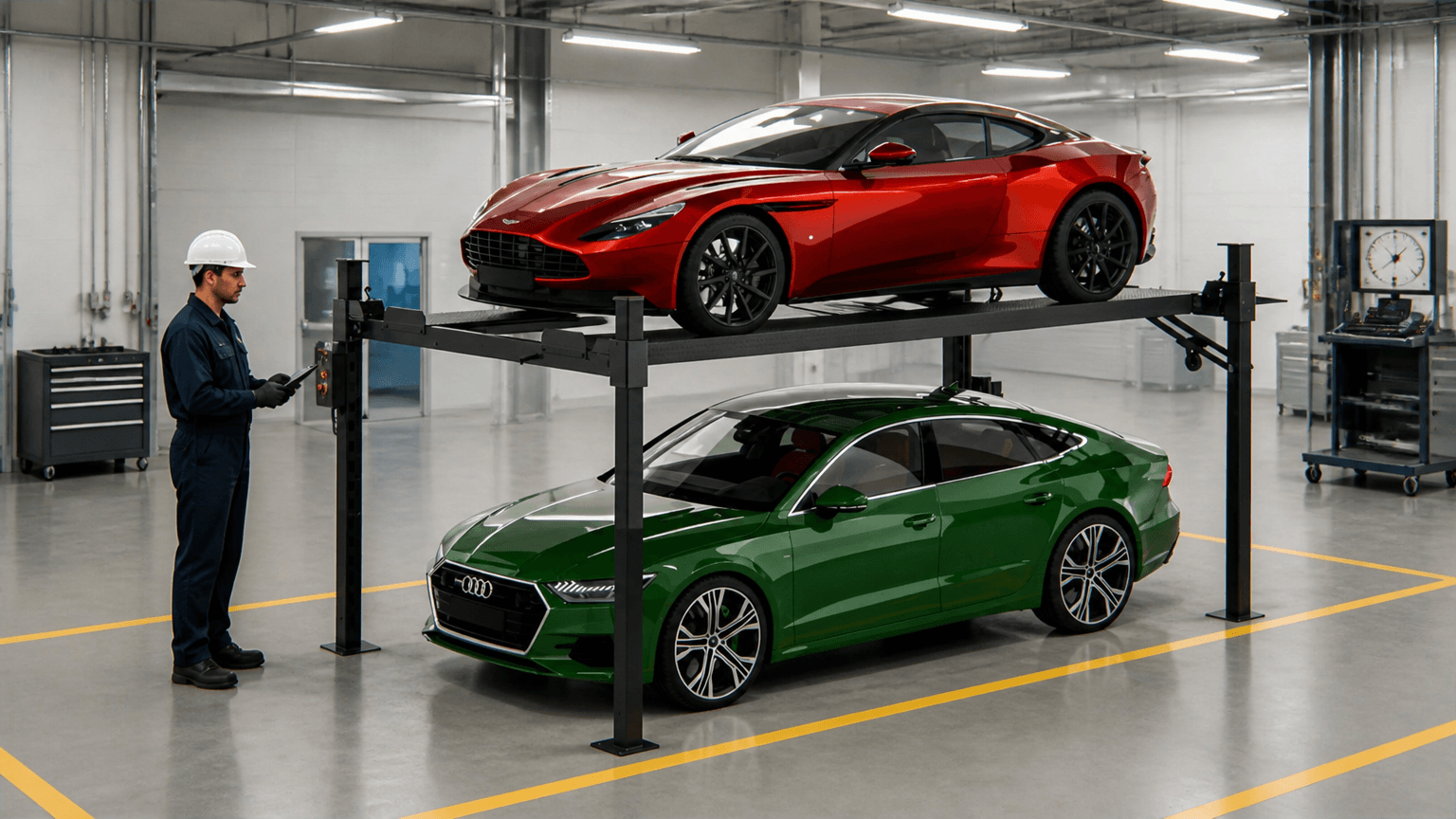
A raised platform must remain supported if hydraulic pressure falls, a hose fails or the drive system loses power. Manufacturers achieve this through a combination of measures rather than one component. Depending on the design, these may include positive mechanical locking positions, hydraulic rupture or anti-burst valves, controlled lowering valves and synchronisation arrangements.
The key buyer question is not simply, “Does it have a safety lock?” Ask what physically supports the platform when it is parked at height, how the locks engage, how engagement is confirmed and what prevents a sudden descent if hydraulic pressure is lost. Request a functional demonstration under load and include the result in the commissioning record.
What to verify
- Positive load-holding method at the raised parking position
- Protection against hydraulic line or hose failure
- Controlled and synchronised platform descent
- A documented test showing the safety devices functioning under load
Safety Group 2: Controlled Movement and Prevention of Unintended Operation
Safe control design prevents the lift from moving at the wrong time or continuing beyond its intended travel. Typical implementations include hold-to-run controls, clearly identified emergency stops, upper and lower travel limit switches, lock-release interlocks and control logic that prevents incompatible commands.
For a parking application, control position also matters. The operator should be able to observe the movement zone or the system should provide equivalent safeguarding. A control box placed where the operator cannot see beneath the platform creates a foreseeable risk even if every component is individually certified.
What to verify
- Emergency stop location and reset behaviour
- Upper and lower travel limit protection
- Interlock between platform movement and lock release
- Operator visibility, warning signals and control labelling
Safety Group 3: Rated Capacity, Structural Stability and Overload Protection
Rated capacity is a design limit, not a recommended everyday target. The selected lift should exceed the heaviest foreseeable vehicle weight, including accessories, cargo and future vehicle changes. This is particularly important as large electric SUVs and pickup trucks can be substantially heavier than the vehicles originally assumed during early project planning.
SHININNOVATION’s verified product range illustrates why model selection must be specific. The PTP two-post series covers 2,000–3,000 kg and offers lift heights of 1,800 or 2,100 mm. The four-post range extends from the 3,600 kg PFP36/1800 to the 4,000 kg PFPS40/1800 and 5,000 kg PFP50S/2100. These figures are model ratings; they do not remove the need to verify the installation slab, anchors, load distribution and intended vehicle mix.
| Model | Rated capacity | Lift height | Primary buyer check |
|---|---|---|---|
| PTP25/2100 | 2,500 kg | 2,100 mm | Vehicle weight and cantilever load path |
| PTP30/2100 | 3,000 kg | 2,100 mm | Heavier SUV clearance and slab condition |
| PFP36/1800 | 3,600 kg | 1,800 mm | Drive-on runway and four-column anchoring |
| PFPS40/1800 | 4,000 kg | 1,800 mm | Heavy-vehicle margin and load distribution |
Ask the supplier for the model-specific rated load, structural calculations or validation evidence, and the overload-protection method. A brochure showing a vehicle on a platform is not proof of rated capacity.
Safety Group 4: Crushing, Shearing and Access to the Movement Zone
The space beneath and around a moving platform creates crushing and shearing hazards. The correct safeguards depend on the installation: private locked garages, shared residential basements and public commercial car parks present different levels of foreseeable access.
Risk reduction may involve physical guards, restricted access, warning devices, maintained clearances, perimeter detection or operating procedures. The important point is that the safety concept must match the site. A system acceptable in a controlled private bay may require additional protection when installed where children, visitors or untrained drivers can enter the movement zone.
What to verify
- Identified crushing and shearing zones in the risk assessment
- Required guards, sensors or access restrictions for the actual site
- Warning signage and audible or visual alerts
- Safe clearances and an unobstructed emergency-stop route
Documents to Request Before Shipment
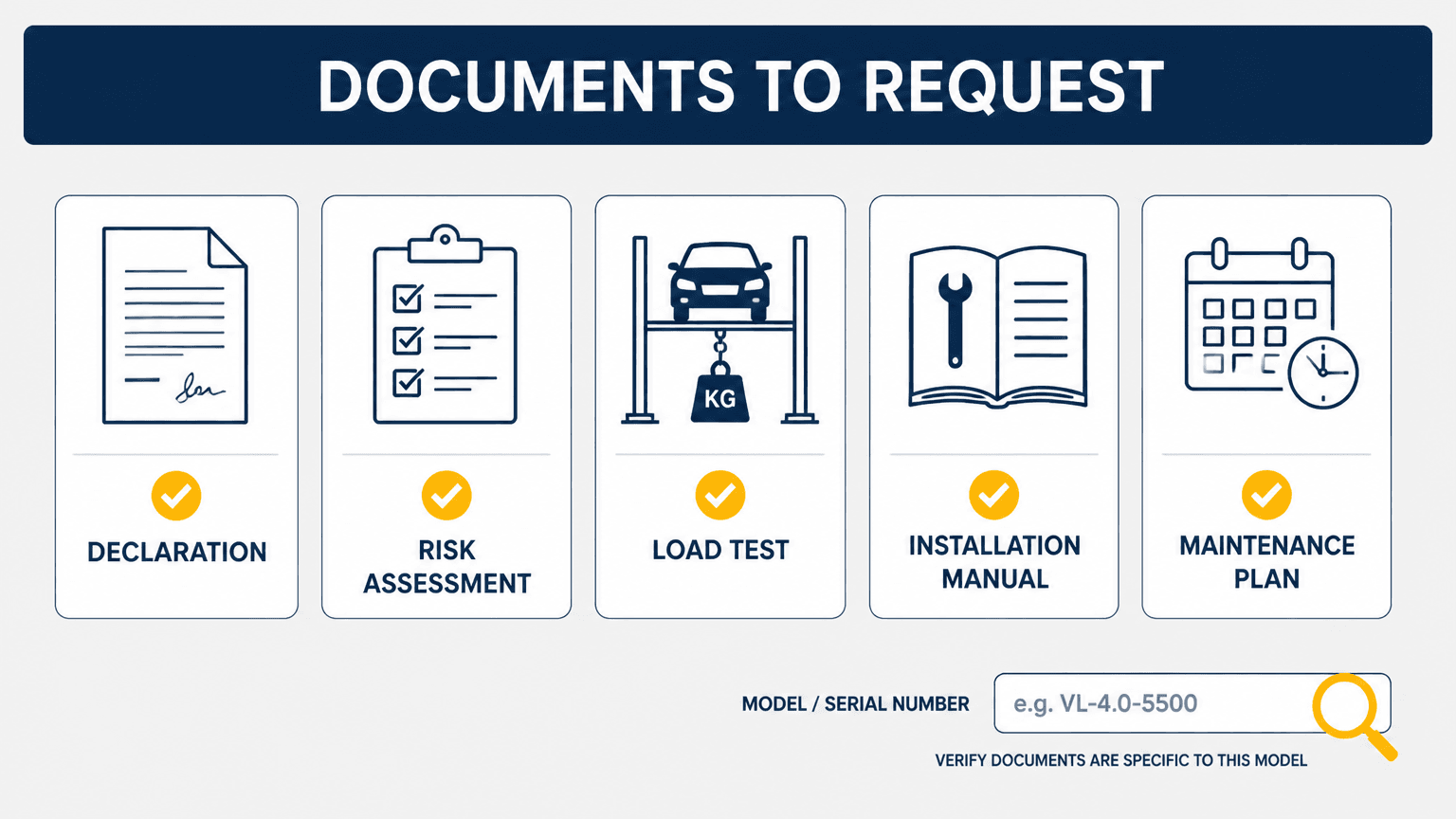
A serious compliance review is document-based. Before releasing the final payment or approving shipment, request the following package for the exact model on the purchase order:
| Document | What it should confirm | Common red flag |
|---|---|---|
| EU Declaration of Conformity | Manufacturer, exact model, applicable legislation and standards | Generic company certificate with no model |
| Risk assessment | Hazards, protective measures and residual risks | No reference to the intended installation environment |
| Test or validation record | Rated-load and safety-device verification | Photos without test conditions or results |
| Installation manual | Slab, anchors, electrical supply and commissioning sequence | One manual reused across unrelated models |
| Maintenance schedule | Inspection points, service intervals and replacement parts | No procedure for checking locks or hydraulic components |
Installation and Inspection Still Matter
A compliant machine can become unsafe through poor installation. Anchor selection, slab condition, column alignment, hydraulic bleeding, electrical isolation and commissioning tests all affect the installed result. In workplaces, local inspection requirements may apply in addition to the product standard. The UK Health and Safety Executive, for example, emphasises thorough examination by a competent person for lifting equipment and specifically notes the importance of examination after on-site assembly where applicable.
Keep the Declaration of Conformity, installation record, anchor-torque record, commissioning checklist and subsequent inspection reports together for the life of the equipment. These documents support maintenance decisions, insurance reviews and future resale.
Practical Buyer Checklist
- Confirm whether EN 1493, EN 14010 or both are relevant to the selected system.
- Match the declaration and test evidence to the exact model number.
- Verify how the platform is mechanically or hydraulically protected against uncontrolled descent.
- Check the emergency stop, travel limits and lock-release interlocks.
- Select rated capacity using the heaviest foreseeable vehicle, not today’s average vehicle.
- Review crushing-zone protection against the actual users and access conditions.
- Approve the slab, anchors, electrical supply and commissioning method before shipment.
Engineering Review
Need a model-specific compliance package?
Send us the destination market, intended model, vehicle weights and site conditions. We will identify the applicable documentation and installation checks before quotation.
Request an Engineering ReviewFurther reading: CEN-CENELEC: What is a European Standard?; UK HSE: Thorough examinations of lifting equipment; Automotive Lift Institute: Standards development.
Related SHININNOVATION resources: Two-post parking lift specifications; Four-post parking lift specifications; Custom parking systems engineering guide.